
The Nasdaq pulls back, but 4FT Invest’s automated strategies keep generating profits even during the correction.

Wall Street slows, but algorithmic trading speeds up
The Nasdaq pulls back, but 4FT Invest’s automated strategies keep generating profits even during the correction.
After the strong opening on Monday, November 10, today’s session saw the Nasdaq retrace by nearly -1%, settling around -0.74% at the time of writing. Tech stocks — the undisputed leaders of the early-month rally — are now showing the first signs of pressure, particularly in the artificial intelligence (AI) sector, where several analysts are beginning to see speculative dynamics reminiscent of the dot-com bubble of 2000.
The broader U.S. macroeconomic environment remains complex: the partial federal government shutdown continues to weigh on confidence and drain liquidity from the system, while the U.S. sovereign debt has reached record levels, fueling concerns in both bond and currency markets.
Overall, market sentiment across Wall Street has turned increasingly tense. Following its strong start to the week, the Nasdaq’s pullback underscores a fragile balance between enthusiasm and fear.
Behind the index’s fluctuations lie three key factors shaping the current macro picture: the shadow of a potential AI bubble, record-high U.S. debt, and the ongoing federal shutdown that is partially paralyzing the economy.
The Shadow of an AI Bubble
After months of sharp gains driven by AI-related optimism, the tech sector is beginning to show cracks.
Valuations of many AI-linked companies — from chipmakers to software developers — have reached levels comparable, in dynamic, to the dot-com bubble of the early 2000s.
According to Goldman Sachs and the Bank of England, the main risk lies in a widening gap between expectations and tangible results, within a market increasingly concentrated around a handful of mega-cap stocks.
If AI-related revenues were to slow, the correction could be substantial and potentially drag down the broader tech sector.
U.S. Sovereign Debt: The Fragile Giant

At the same time, the U.S. national debt has surpassed $38 trillion, prompting analysts to question the long-term sustainability of federal finances.
Debt servicing now consumes a growing share of the federal budget, while political gridlock makes it difficult to pass new fiscal discipline measures.
A loss of investor confidence could push Treasury yields higher, creating a vicious cycle of rising financing costs and added pressure on equity markets.
The fiscal credibility of the United States — once the bedrock of the global financial system — now appears less solid than in the past.
Shutdown: Institutional Instability Weighs on the Economy
Compounding the picture, the federal government shutdown that began in October has already halted parts of the U.S. administrative system.
Over 900,000 federal employees are either furloughed or working without pay, while delays in macro data releases and public contracts are creating uncertainty for both businesses and investors.
Each week of paralysis costs fractions of GDP, undermining confidence among consumers and markets alike.
If the shutdown continues, it risks triggering a domino effect — slower growth, a weaker dollar, and mounting pressure on interest rates.
A Fragile Balance, but with Opportunities
In a market dominated by high volatility and mixed sentiment, 4FT Invest’s quantitative and algorithmic trading strategies continue to stand out.
Thanks to sophisticated money management and a data-driven approach, 4FT Invest succeeds in turning market instability into trading opportunities, capturing the most efficient moves in both directions.
Algorithmic Trading in Action
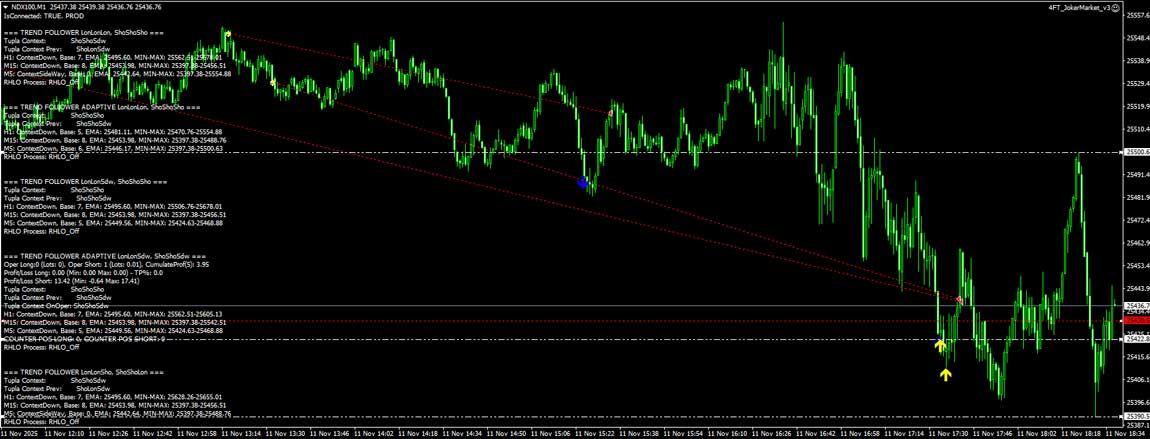
Amid this volatile and uncertain backdrop, 4FT Invest’s algorithmic trading system proves robust and responsive.
With advanced risk control and dynamic trade optimization, the algorithm consistently extracts value even during retracements — preserving capital and maximizing profit potential.
The trading chart reveals three profitable short positions and one ongoing short in take-profit, confirming the system’s ability to adapt to trend shifts and capitalize on market corrections.
The quantitative, disciplined approach of 4ftinvest demonstrates how, even in unstable markets, a well-calibrated automated strategy can make the difference between suffering volatility and profiting from it.
The information contained in this article is for informational purposes only and does not constitute financial advice or an investment solicitation. Past performance is not indicative of future results.

© 4FT Invest LTD. All rights reserved
