
Energy inflation, Middle East tensions, and the moves of the FED, ECB, BOE, BOJ, and RBA are shaping the global bond market.
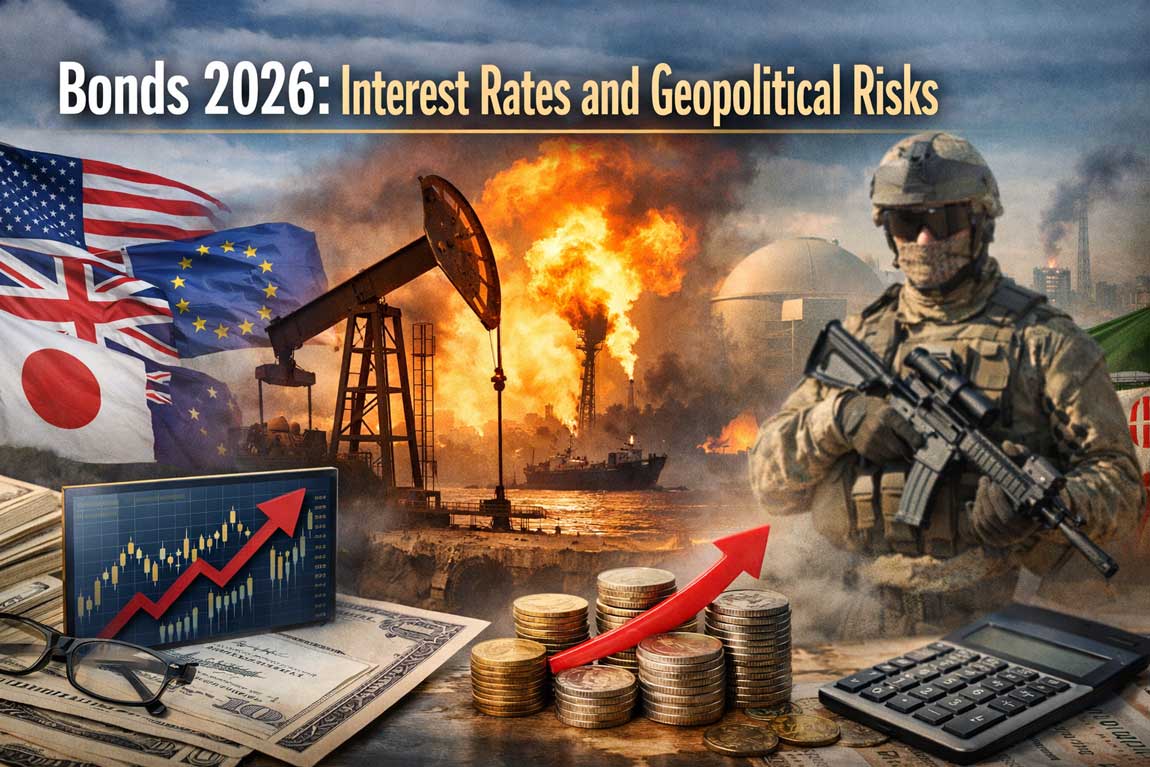
Bonds 2026: Interest Rates and Geopolitical Risks
Energy inflation, Middle East tensions, and the moves of the FED, ECB, BOE, BOJ, and RBA are shaping the global bond market.
Bond Market: Interest Rates Under Pressure in 2026
The year 2026 is opening with a global bond market strongly influenced by two key factors: on one side the monetary policies of the major central banks, and on the other the increase in geopolitical risks that could directly affect inflation, particularly through the energy channel.
After the long tightening cycle that began in 2022 and continued over the following two years, 2025 had suggested the possibility of a stabilization phase for interest rates. However, the beginning of 2026 has reignited inflation concerns, especially due to international tensions involving the Middle East.
For bond markets, this means greater volatility in yields and a reassessment of expectations regarding future interest rate cuts.
Interest Rate Trends Since the Start of the Year
During the first months of 2026, government bond yields have shown an upward trend or at least stabilization at relatively high levels.
In the United States, Treasury yields have remained elevated, reflecting a still resilient economy and expectations of cautious monetary policy.
In Europe, government bonds have followed a similar dynamic. German Bunds remain the benchmark for the euro area, while Italian BTPs continue to offer higher yields, maintaining a spread with Germany that remains relatively controlled but sensitive to macroeconomic and political developments.
Markets are gradually revising expectations for rate cuts this year, assuming that some central banks may maintain a restrictive stance longer than previously expected.
Central Banks and the Risk of Energy Inflation
Federal Reserve (FED)
In the United States, the Federal Reserve continues to maintain a cautious approach. Core inflation remains above the 2% target and the labor market still shows solid conditions.
A potential rise in energy prices, linked to geopolitical tensions, could further complicate the path toward full inflation stabilization. For this reason, the FED maintains a flexible stance, leaving open the possibility of keeping interest rates elevated for longer.
European Central Bank (ECB)
The ECB finds itself in a particularly delicate position. The European economy is growing slowly and at the same time remains highly exposed to energy costs.
Geopolitical tensions in the Middle East, particularly the current situation in Iran and the risk of a broader regional conflict, represent a potential shock factor for energy prices. A significant increase in oil and gas prices could place renewed pressure on inflation across the euro area.
For this reason, some members of the Governing Council have begun to avoid completely ruling out the possibility of renewed monetary tightening if inflation were to accelerate again.
Bank of England (BOE)
The Bank of England continues to deal with one of the most persistent inflation rates among advanced economies. The United Kingdom is particularly sensitive to developments in energy and food prices.
If geopolitical tensions translate into higher energy costs, the BOE could be forced to maintain a restrictive monetary policy for longer than expected.
Bank of Japan (BOJ)
Japan is currently experiencing a gradual transition away from the ultra-accommodative policies adopted over the past decades. Inflation, although moderate compared to Western economies, has pushed the Bank of Japan to begin a process of monetary normalization.
Energy prices also represent a crucial variable for Japan, given the country’s heavy dependence on energy imports. A rise in oil prices could accelerate the normalization process.
Reserve Bank of Australia (RBA)
Among the major central banks, the Reserve Bank of Australia is the one that could most concretely consider further rate hikes in the short term.
Inflation in Australia remains above target and the housing market continues to show signs of tension. A rise in energy commodity prices, to which the Australian economy is significantly exposed through global markets, could further strengthen inflationary pressures.
Iran, Geopolitical Tensions and the Energy Market
One of the main risk factors for 2026 concerns the evolution of tensions in the Middle East, with particular attention to the situation involving Iran.
Iran represents a strategic hub in the global energy market, both for its oil production and for its geographic position near the Strait of Hormuz, through which a significant share of global oil supplies transit.
A military escalation or a broader regional conflict could have immediate effects on energy prices, potentially driving significant increases in both oil and gas prices.
For central banks, this scenario represents one of the main macroeconomic risks: rising energy prices could generate a new wave of inflation precisely at a time when advanced economies were beginning to observe signs of disinflation.
Implications for the Bond Market
In this environment, the bond market remains particularly sensitive to interest rate expectations.
If geopolitical risks translate into renewed inflationary pressure, central banks could delay rate cuts or, in extreme scenarios, even consider new hikes.
This could lead to:
For European government bonds, including Italian BTPs, this could mean a phase of yield fluctuations linked both to ECB decisions and to the perception of global risk.
Summary and Insights for Investors
The year 2026 appears to be one in which the bond market will be driven by the interaction between monetary policy and geopolitics.
Several key points stand out:
For investors, fixed income is once again becoming an important component of portfolios, but it requires careful analysis of the global macroeconomic environment.
The information contained in this article is provided for informational purposes only and does not constitute financial advice, investment recommendations, or solicitation to invest.
© 4FT Invest LTD. All rights reserved
