
BTP–Bund near 60 bps, Treasuries at 4.2% and Gilts at 4.5%: data-dependent central banks and new tensions over U.S. debt
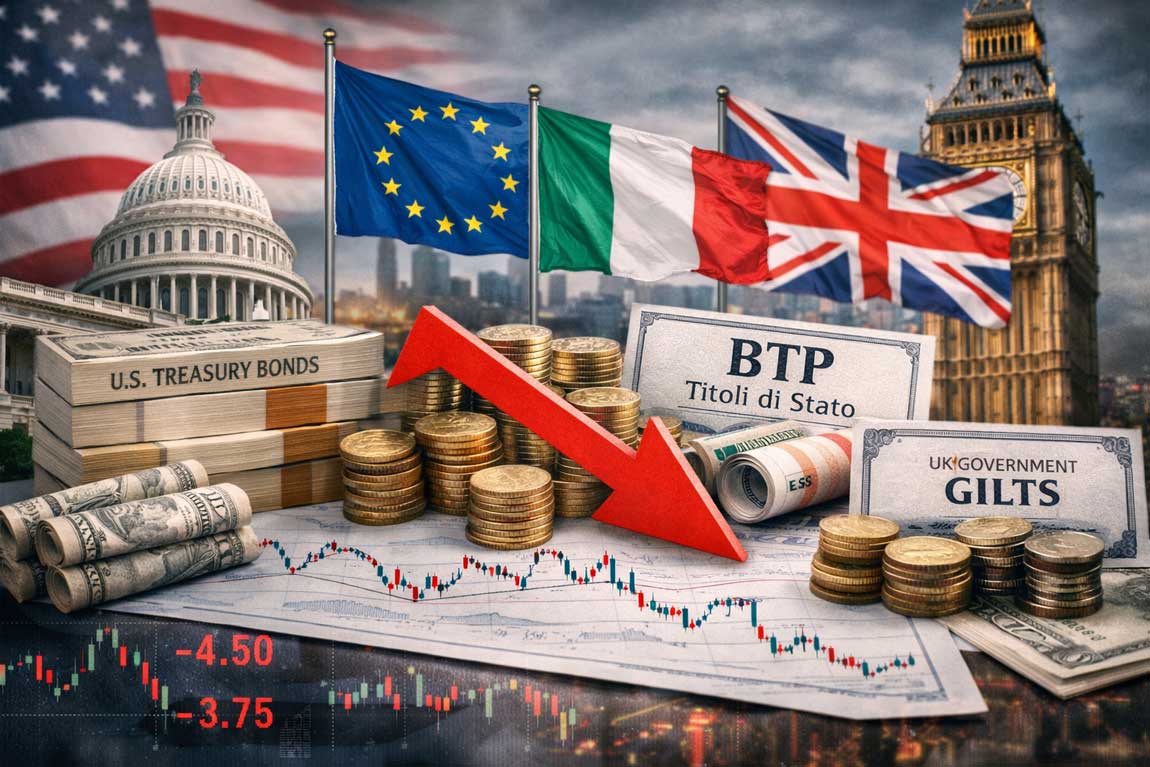
Government bonds: yields between pause and risks
BTP–Bund near 60 bps, Treasuries at 4.2% and Gilts at 4.5%: data-dependent central banks and new tensions over U.S. debt
Stable rates with markets focused on global macro data and the U.S. debt risk looming over all markets.
Government bond markets reach mid-February with a “split” picture: on the one hand, disinflation has reinforced expectations of a gradual normalization of rates; on the other, politics (especially in the United Kingdom), the issue of U.S. public debt, and central banks’ balance-sheet management choices continue to generate volatility in yields.
Europe: spreads under control, but duration remains sensitive
In the euro area, yields are moving within a relatively orderly range, with the curve reacting mainly to inflation and growth data. As of 10 February 2026, the Italian 10-year BTP is trading around 3.45%, while the 10-year Bund is near 2.83%, putting the implied spread at roughly 60–65 basis points.
On the long end of the curve of major European sovereigns, the Italian 10-year BTP continues to offer a higher yield than core peers at the same maturity. Yields remain sensitive to inflation dynamics and monetary-policy expectations.
The French 10-year OAT is trading slightly below Italy, around 3.43%.
The market message is clear: the peripheral “risk premium” is currently contained, but extending duration remains vulnerable to macro surprises and geopolitical shocks.
On the monetary-policy front, the ECB has confirmed its wait-and-see stance: the deposit rate remains at 2.00% (main refinancing 2.15%, marginal lending 2.40%), unchanged at the latest meeting thanks to euro-area inflation slowing to 1.7% year on year in January 2026, below the 2% target. This reinforces a “meeting-by-meeting” approach rather than a clearly defined path of cuts or hikes.
Internal debate revolves around the risk of temporarily below-target inflation: according to recent statements, some Governing Council members stress that the current level is “appropriate” despite falling inflation, reiterating the meeting-by-meeting approach.
In Italy, industrial production is showing signs of recovery relative to expectations (previous monthly reading -0.2%), with the key figure due to be updated on 11 February (December index, ISTAT release).
What the market will watch in the coming weeks (Euro area):
United States: Treasuries around 4.2% as markets await macro data
In the U.S., the 10-year Treasury is around 4.19% (10 February) after short-term fluctuations in recent weeks, with the curve under close scrutiny as it reflects expectations for Fed Funds cuts and uncertainty over the U.S. fiscal outlook.
The Federal Reserve has kept the Fed Funds target range at 3.50–3.75%, signalling a data-dependent approach rather than a commitment to immediate rate cuts. This stance feeds into long-term yield expectations, where the risk premium (term premium) remains a key factor.
Market attention is not only on “if” and “when” rate cuts will resume, but also on the mix between rates and balance-sheet management: recent comments suggest that any shift in balance-sheet policy could take time, increasing uncertainty on the long end of the curve (term premium), especially if markets perceive weaker “structural demand” for Treasuries from institutions.
Key drivers for Treasuries (Q1 2026):
U.S. debt and “rumours” about China and Japan
The issue of federal debt has returned to centre stage as a market risk factor. As of 4 February 2026, U.S. gross public debt is estimated at USD 38.56 trillion; as a technical reference, the update points to an average interest rate on marketable national debt of 3.348% (January 2026).
On the foreign-demand side for Treasuries, the latest official data show high overall holdings by foreign investors, while China’s share has declined to multi-year lows.
In recent hours, there have also been reports—cited by international sources—that Chinese regulators have advised financial institutions to reduce exposure to Treasuries for concentration and volatility reasons.
As for Japan, the issue is more political than tactical: a recent analysis noted that Japan’s foreign-exchange reserves (around USD 1.4 trillion) are invested “largely” in Treasuries, and that the domestic debate has revived the idea of using excess reserves for fiscal purposes—an option many analysts see as risky and potentially destabilising, given the sensitivity of the U.S. market to large-scale sales.
Implications for yields: even if a coordinated “flight” from Treasuries is not the base case, a rise in perceived probability alone tends to lift the term premium and make the long end of the U.S. curve more fragile.
United Kingdom and the BoE: jittery yields and signals of cuts
In the UK, 10-year Gilts remain around 4.5%, showing volatility linked to political uncertainty and weaker growth prospects. The Bank of England has left the Bank Rate at 3.75%, with a minority of members in favour of immediate cuts—indicating that rates could fall, but only depending on upcoming inflation and growth data.
The U.S. debt issue: a systemic risk for sovereign bonds
One of the most discussed structural factors is the enormous stock of U.S. public debt, which surpassed USD 38 trillion in 2025—a record level reflecting decades of structural deficits and economic shocks. This amount is considered historically high and raises concerns over sustainability and market vulnerability.
Debt size directly affects government yields: greater supply of bonds implies potential upward pressure on yields if demand fails to keep pace. Moreover, the perceived risk of a U.S. debt crisis—while not the base case, but not entirely negligible—would have profound global impacts:
A U.S. debt crisis, even if unlikely in the near term, could trigger a global repricing of Western sovereign bonds, including Bunds and BTPs, widening spreads and increasing financing costs for states and companies.
Another factor to note is recent regulatory pressure in China: financial authorities reportedly urged institutions to reduce exposure to Treasuries to limit concentration risk—a signal that weighs on perceptions of foreign demand for U.S. debt, even if it does not directly involve official state reserves.
Macro data ahead: figures that could move markets
Tomorrow, markets will closely monitor several key indicators:
What could happen in bond markets:
Government bond markets remain in a precarious balance, with relatively high rates and data-dependent central banks. Systemic risk linked to U.S. debt and upcoming macro releases are key drivers that could generate significant moves in yields across all major Western sovereign bonds in the short to medium term.
© 4FT Invest LTD. All rights reserved
