
Geopolitical escalation and conflicting news drive volatility across global equities, bonds, and commodities
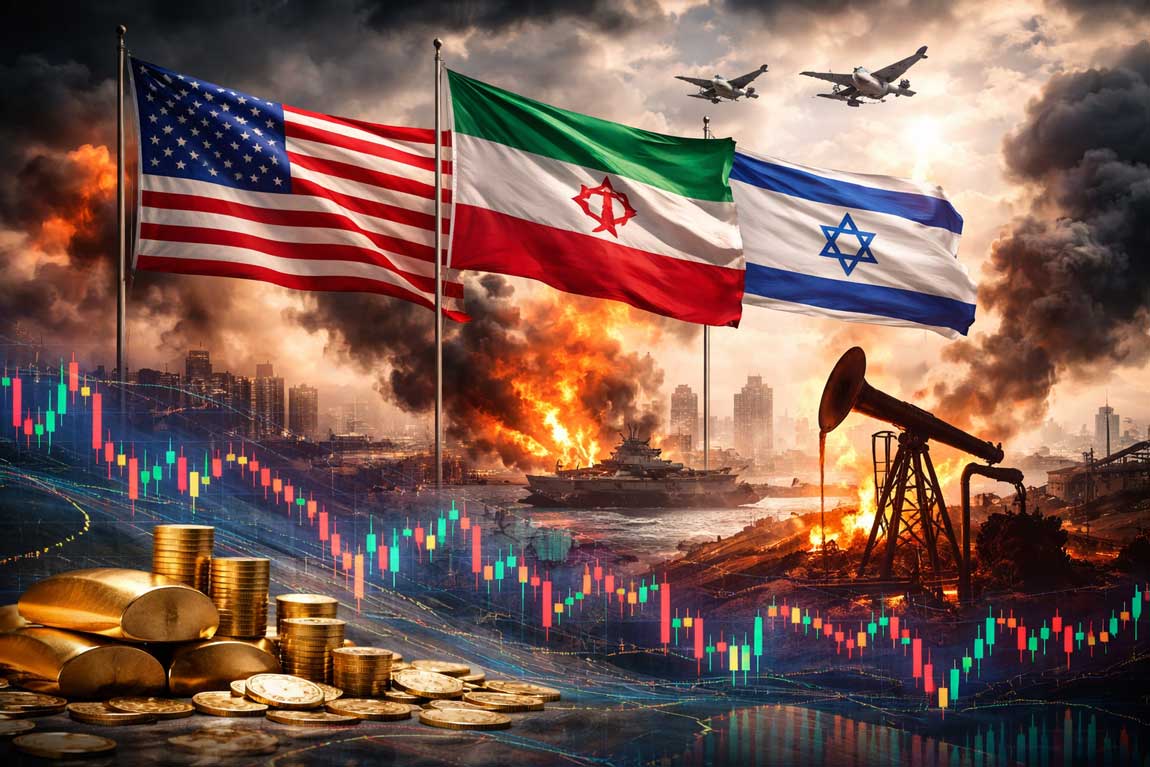
US–Iran Tensions: Markets on Edge
Geopolitical escalation and conflicting news drive volatility across global equities, bonds, and commodities
In recent days, the fragile balance between the United States, Israel, and Iran has created a scenario of heightened geopolitical uncertainty, directly and immediately impacting global financial markets. News flows—often contradictory, and in some cases denied or retracted within hours—have fueled an environment of extreme volatility, where market participants are reacting more to the speed of information than to its actual reliability.
Recent developments and an uncertain narrative
Over the past week, reports of potential coordinated military operations by the United States and Israel against Iranian targets initially triggered a flight to safe-haven assets, before being scaled back by more cautious official statements.
Adding further complexity are the latest reports from Pakistani sources, suggesting that a breakthrough in talks between Washington and Tehran could emerge within 48 hours. According to these sources, cited by Anadolu Agency, Iran has set very strict conditions: guarantees on future security, exclusion of its missile program from any negotiations, and demands for economic compensation. At the same time, Turkey and Pakistan are reportedly playing an active mediating role in an attempt to facilitate a potential agreement.
However, these diplomatic signals coexist with official Iranian statements denying that any real negotiations are underway, further fueling uncertainty and contributing to an extremely unstable information environment.
Impact on equity markets
Global equity indices have reacted unevenly but share a common feature: rising volatility, with significant moves already visible since the start of the week:
The result is a “jerky” market, where intraday movements are often disconnected from long-term fundamentals and strongly driven by geopolitical headlines.
Bond market: an unstable safe haven
In fixed income, the US 10-Year Treasury yield has alternated between declines—typical of a flight to safety—and sharp rebounds, in line with rapidly shifting market sentiment.
This instability highlights how even traditionally defensive assets are now subject to faster and less predictable swings.
Commodities: gold and oil driven by headlines
Commodities remain the most immediate barometer of the crisis:
In both cases, price action is being driven more by information flows than by underlying supply-demand fundamentals.
A market driven by speed
In a landscape dominated by conflicting headlines, denials, and unpredictable diplomatic developments, the ability to react quickly has become crucial. The recent news regarding a possible negotiation breakthrough—immediately counterbalanced by rigid positions and official denials—perfectly illustrates a market moving on informational impulses.
In such an environment, automated and algorithmic systems prove particularly effective: they remove emotional bias, operate with discipline, and respond in real time to changing conditions. Solutions such as the algotrading offered by 4ftinvest.com fit into this context, providing a structured approach capable of adapting to markets characterized by sudden spikes and high uncertainty.
Disclaimer: The information contained in this article is for informational purposes only and does not constitute financial advice, investment solicitation, or an operational recommendation.
© 4FT Invest LTD. All rights reserved
