
The cycle is improving, but CPI, PPI and oil are narrowing the window for the Fed, ECB and BoE.

The global economy enters spring 2026 with an ambiguous signal: growth has not faded, but inflation is making itself felt again just as markets had begun to price in a new expansionary phase. The reading proposed by the 4FT Invest Ltd model points in this direction: the general phase is indicated as the beginning of expansion, after a long slowdown phase. However, the signal is not yet “clean”: in the 4FT dashboard, expansion dominates, but slowdown remains close, while recession appears residual. It is therefore a nascent expansion, not yet consolidated growth.
The key issue is timing. Many macro indicators still reflect the fourth quarter of 2025 and the first quarter of 2026; only part of the April data is beginning to incorporate the energy and geopolitical shock linked to the Middle East. In the United States, April CPI has already changed the tone of the debate: annual inflation rose to 3.8%, above the 3.7% forecast, with monthly CPI at +0.6% and core CPI at 2.8%; FRED reports a seasonally adjusted CPI of 332.407 for April, while the non-seasonally adjusted series stands at 333.020. The main driver is energy: Trading Economics reports energy costs up 17.9% year-on-year, gasoline +28.4% and fuel oil +54.3%.
US growth, however, is not in recession. Real GDP in the first quarter rose by an annualized 2.0%, below the 2.3% consensus, but accelerating from 0.5% in the previous quarter; FRED places real GDP at $24,174.527 billion in chained 2017 dollars. Trading Economics, however, forecasts a slowdown toward 1.10% by the end of the quarter, suggesting that momentum could weaken just as inflation moves back above target.
The labor market remains the main argument in favor of the 4FT scenario of early expansion. Nonfarm payrolls increased by 115,000 in April, above the 62,000 consensus, with March revised to 185,000; FRED shows total nonfarm employment at 158.736 million. The unemployment rate remained at 4.3%, in line with expectations, but labor force participation fell to 61.8%, the lowest since October 2021: the data therefore look solid on the surface, but less robust in their composition.
The industrial side is more controversial. The US ISM Manufacturing Index remained at 52.7 in April, still in expansion, but below the 53.0 consensus; new orders improved to 54.1, while manufacturing employment fell to 46.4. Industrial production in March declined by 0.5% month-on-month versus expectations of +0.1%, and FRED places the INDPRO index at 101.7898. Capacity utilization also fell to 75.7%, below the 76.3% consensus and far from its historical average.
Consumption, by contrast, continues to support the cycle. US retail sales in March rose by 1.7% month-on-month, above the 1.4% consensus, with FRED reporting retail and food services sales at $752.063 billion. But the details are less reassuring: a significant part of the increase came from gasoline stations, up 15.5%, meaning higher energy prices rather than stronger real volumes.
The next test will be the PPI. In March, US producer prices rose by 0.5% month-on-month, below the 1.1% consensus, but with goods up 1.6% and energy up 8.5%. FRED reports the all-commodities PPI index at 274.102 in March; the April figure is scheduled for release on May 13, and the consensus cited by the macro calendar is for +0.5% month-on-month. A PPI reading above expectations would make it harder to dismiss the CPI move as a simple temporary energy shock.
Outside the United States, the picture is equally mixed. The Eurozone grew by only 0.1% quarter-on-quarter in the first quarter, below the 0.2% consensus, and by 0.8% year-on-year, below expectations of 0.9%. At the same time, Eurozone inflation rose to 3.0% in April from 2.6% in March, with monthly CPI at +1.0% and the energy component at +3.0%. In China, by contrast, first-quarter GDP rose by 5.0% year-on-year, above the 4.8% forecast, but inflation also moved there: April CPI was +1.2% versus expectations of 0.8%, and PPI was +2.8% versus a 1.6% forecast.
For central banks, this is the turning point. The Fed kept its target range at 3.50%-3.75% for the third consecutive meeting, but the mix of above-expected inflation and still-resilient employment reduces the room for imminent cuts. After the CPI release, the market is shifting its center of gravity toward “higher for longer”: Reuters points to expectations of a low probability of rate cuts in 2026, while Trading Economics describes an environment in which oil, inflation and still-robust real data force the Fed to remain cautious.
In Europe, the dilemma is even more delicate: the ECB left rates unchanged in April, with the deposit rate at 2.0%, the main refinancing rate at 2.15% and the marginal lending rate at 2.40%, but the increase in energy inflation is reopening the debate over possible rate hikes. Joachim Nagel of the Bundesbank indicated that a rate hike becomes more likely if the price outlook does not improve. Meanwhile, the Bank of England kept the Bank Rate at 3.75%, with an 8-1 vote and one member favoring an increase to 4%.
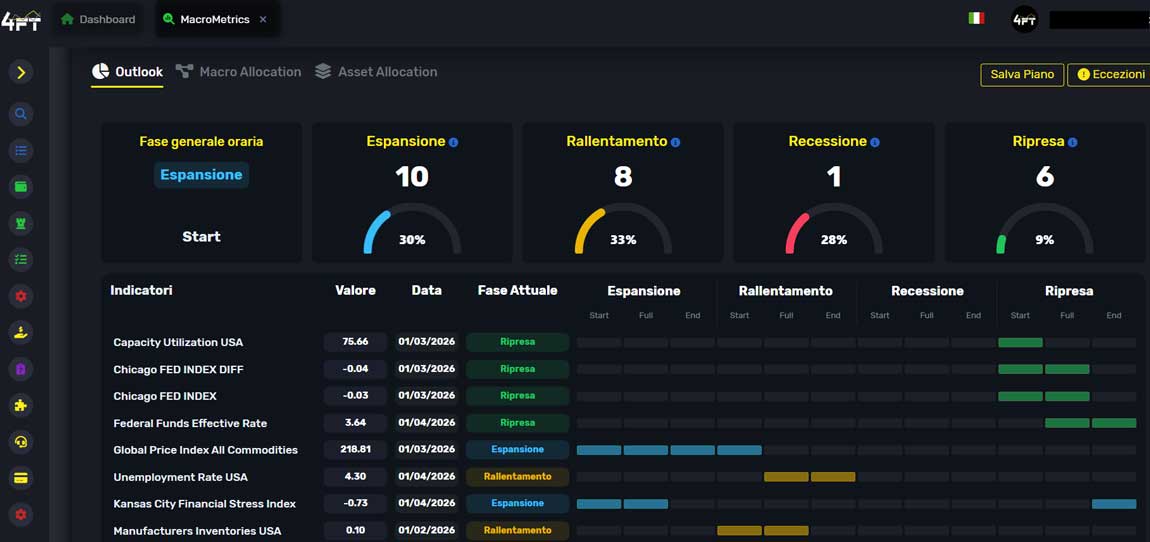
The 4FT Invest Ltd interpretation is therefore consistent with what markets are pricing: a transition from slowdown to recovery/expansion. But the model, like all macro models based on published indicators, risks confirming with a delay a picture that may meanwhile be altered by external shocks. In practical terms: if the upcoming PPI, real retail sales, industrial production, manufacturing indices and labor data confirm growth without a further acceleration in prices, the expansion could consolidate. If, however, energy and production costs continue to pass through into core inflation and corporate margins, the scenario could shift toward something closer to mild stagflation: positive growth, but more fragile and with less accommodative central banks.
This is where the risks highlighted by major investors come in. Ray Dalio continues to focus on the debt-deficit-geopolitics nexus: high deficits, possible monetization, loss of confidence in the dollar and international conflicts are, in his view, ingredients for a potential stagflationary crisis. Howard Marks, through recent Oaktree analyses, instead emphasizes dispersion, private credit and AI: he does not necessarily see an immediate systemic crisis, but rather a market in which the selection between winners and losers becomes much more severe. Warren Buffett has drawn attention to excessive speculation, describing markets as being in a “gambling mood,” while Berkshire has accumulated record cash holdings close to $397 billion. Finally, Michael Burry has compared the AI euphoria to the final stages of the dot-com bubble, urging investors to reduce exposure to the most parabolic segments.
The conclusion is that the macro cycle does not deny expansion: it makes it conditional. The 4FT signal of early expansion is plausible because GDP, employment, manufacturing orders and consumption do not point to recession. But the market is pricing in a normalization that could be disrupted by three variables: energy, core inflation and the reaction of central banks. The week of PPI releases, new GDP data and upcoming industrial indicators will show whether expansion remains the central scenario or becomes a narrow window between inflation and slowdown.
Disclaimer
This article is for informational and macroeconomic analysis purposes only. It does not constitute financial advice, investment solicitation, personalized recommendation or an offer to buy or sell financial instruments. The data cited come from sources considered reliable at the time of writing, but may be subject to revision. Any investment decision should be assessed with a qualified adviser, taking into account one’s risk profile, time horizon and financial objectives.
© 4FT Invest LTD. All rights reserved
