
Nvidia confirms the AI boom, SpaceX prepares for a record IPO, while Hormuz remains the key risk for oil and interest rates.
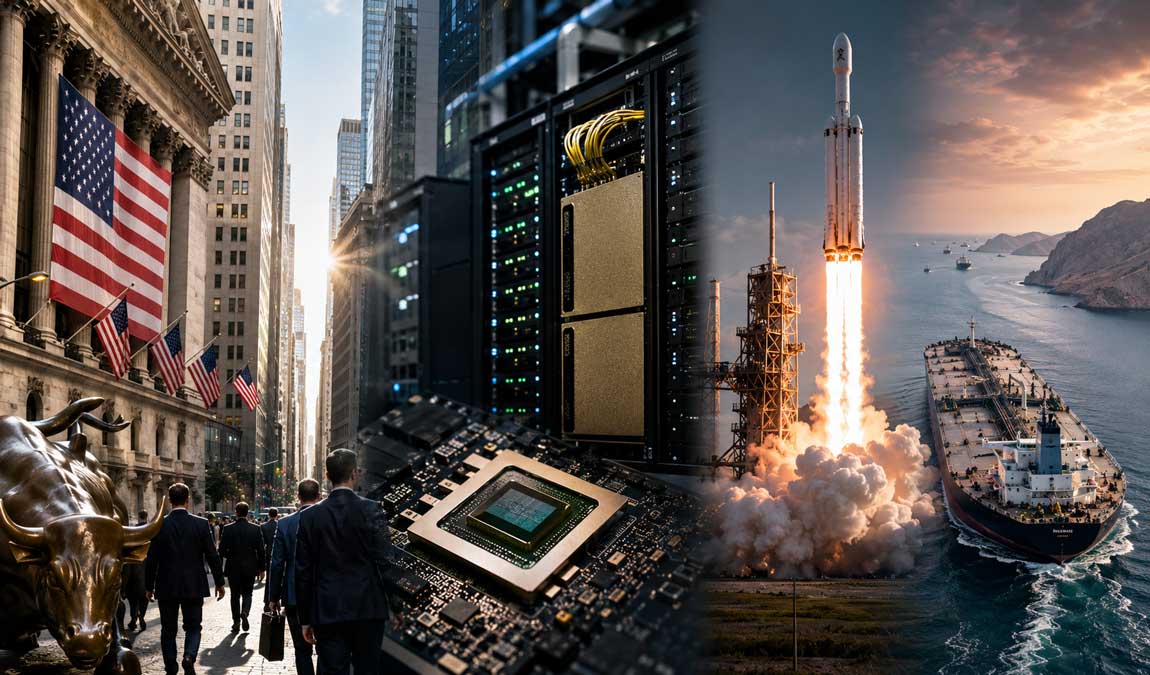
AI and Space Drive Markets to New Highs
Nvidia confirms the AI boom, SpaceX prepares for a record IPO, while Hormuz remains the key risk for oil and interest rates.
The Week Wall Street Bought the Future
Global markets close the week with a rare combination: U.S. indices near or already at record levels, technology still dominant, Asia supported by semiconductors, and energy geopolitics still at the center of macro risk. The immediate catalyst came from Nvidia, which confirmed its role as the global barometer of artificial intelligence: the company reported quarterly revenue of $81.62 billion, above expectations of $78.86 billion, with data center revenue at $75.2 billion and adjusted earnings of $1.87 per share, compared with estimates of $1.76. For the next quarter, the group expects revenue of $91 billion, above the consensus estimate of $86.84 billion.
The message to the market is clear: demand for AI infrastructure remains strong, but not without tension. Nvidia also announced an $80 billion buyback and a dividend increase, yet the stock still corrected in after-hours trading, a sign that a significant portion of optimism is already priced in. The critical issue now is no longer just growth, but its sustainability in 2027–2028, amid supply chains, competition from Big Tech’s proprietary chips, and the monetization of AI inference.
The second symbolic story is SpaceX. This is not yet a completed listing, but an IPO filing that prepares for a possible debut as early as June. According to Reuters, the deal could value the company at up to $1.75 trillion, making it one of the largest IPOs in history and turning SpaceX into one of the world’s most valuable publicly traded companies. The prospectus, however, also highlights significant risks: in the first quarter, SpaceX recorded revenue of $4.69 billion and an operating loss of $1.94 billion, while Starlink remains its only profitable division.
The SpaceX effect has already spread to Europe: Eutelsat rose 22%, OHB gained 7.7%, and SES advanced 3.7%, signaling a repricing of the entire satellite sector.
Hormuz Remains the Hidden Brake on the Rally
The equity rally, however, coexists with an unresolved macro risk: the Strait of Hormuz. Reuters reports that the passage remains close to closure, affecting around one-fifth of global oil flows. ADNOC’s CEO warned that even if the conflict ended immediately, a return to full flows might not occur before the first or second quarter of 2027.
Markets have reacted to “tentative signs” of diplomacy between the United States and Iran, but visibility remains low. Reuters reports Brent crude at $104.56 per barrel, still at elevated levels, while investors are beginning to price in possible Fed rate hikes by the end of the year, in sharp contrast with the rate-cut expectations that prevailed before the conflict.
Performance of Major Indices
| Area | Index | Latest level / close | Recent performance |
|---|---|---|---|
| U.S. | S&P 500 | 7,445.72 | +0.2% session, +0.5% week, +8.8% YTD |
| U.S. | Dow Jones | 50,285.66 | +0.6% session, +1.5% week, +4.6% YTD |
| U.S. | Nasdaq Composite | 26,293.10 | +0.1% session, +0.3% week, +13.1% YTD |
| U.S. | Russell 2000 | 2,843.45 | +0.9% session, +1.8% week, +14.6% YTD |
| Europe | STOXX 600 | 620.56 | unchanged, two-week high |
| Europe | Euro Stoxx 50 | around 6,006 | -0.20% session, +1.89% month |
| Europe | DAX / DE40 | around 24,771 | +0.67% session, +2.55% month |
| Europe | FTSE 100 | 10,443.47 | +0.11% session, -0.31% month |
| Asia | Nikkei 225 | near record highs | +2.8% in Friday’s session |
| Asia | Hang Seng | around 25,700 | about +1.2% in the Asian session |
| Asia | Kospi | around 7,800 | about +0.6% in the Asian session |
| Asia | Shanghai Composite | around 4,100 | about +0.8% in the session |
The U.S. data are updated to the close of May 21, 2026; AP also reports weekly and year-to-date performance. For Europe, Reuters reports the STOXX 600 at 620.56 points, while Trading Economics provides updated data for the Euro Stoxx 50, DAX/DE40 and FTSE 100. For Asia, Reuters and AP indicate broad gains, with the Nikkei, Hang Seng and Kospi advancing, supported by technology, chips and expectations of a possible geopolitical easing.
Market View
The dominant narrative remains technological growth: AI, data centers, semiconductors and space are supporting elevated multiples and flows into growth assets. However, the rally is fragile because it rests on three conditions that are difficult to maintain simultaneously: accelerating earnings, oil under control and interest rates that are not excessively restrictive.
The strength of U.S. indices shows that the market continues to favor quality, technology and liquidity. Europe remains more exposed to energy risk and less directly positioned to benefit from the AI trade, while Asia shows greater polarization: Japan, South Korea and Taiwan are benefiting from the chip cycle, while China remains more selective and tied to stimulus, domestic consumption and trade tensions.
The message of the week is therefore twofold: the market is still buying the future, but the price of that future increasingly depends on two variables outside corporate balance sheets: Hormuz and interest rates.
© 4FT Invest LTD. All rights reserved
