
Between technical support, major players, and volatility: how to navigate the leading U.S. index looking ahead to 2026
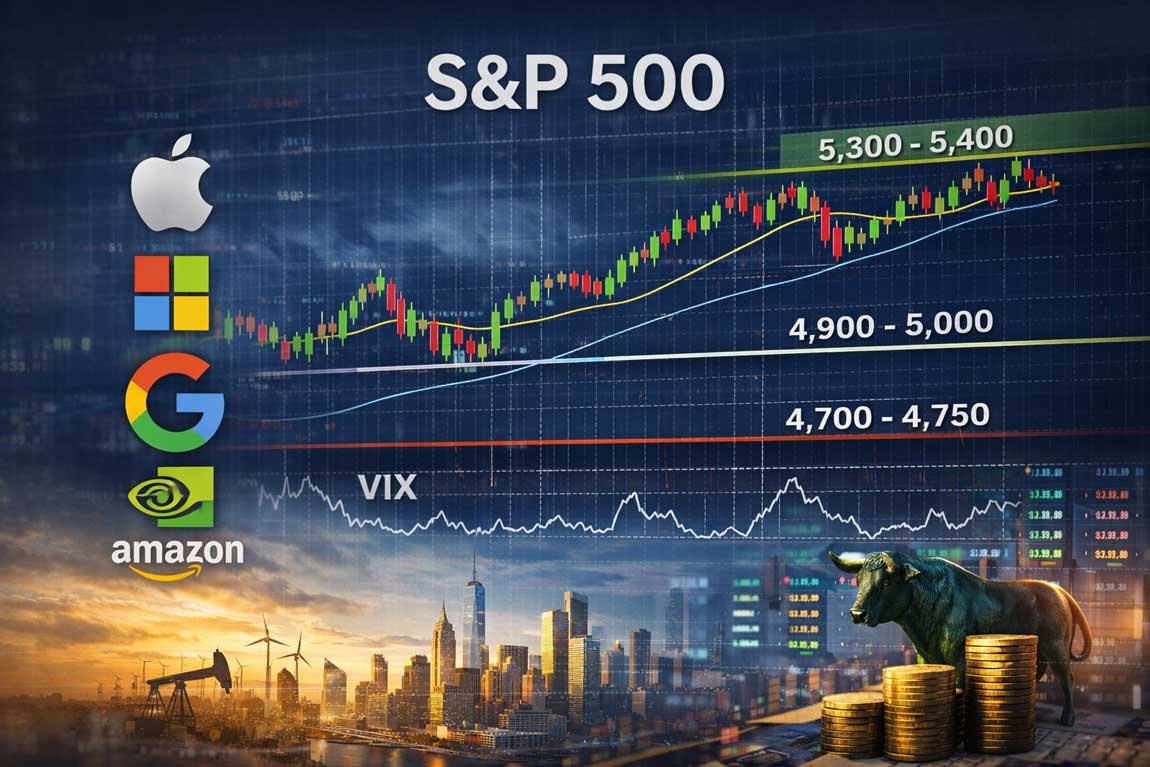
S&P 500: key levels and strategies toward 2026
Between technical support, major players, and volatility: how to navigate the leading U.S. index looking ahead to 2026
S&P 500: a delicate balance between structural strength and new uncertainties
The S&P 500 continues to represent the main benchmark for assessing the health of U.S. equity markets and, more broadly, the global economy. After years of sustained growth, the index is now in a more mature phase of the cycle, characterized by elevated valuations, greater selectivity, and increasing sensitivity to macroeconomic factors.
The current environment is that of a resilient but less linear market: investors remain exposed to equities, yet with a more cautious approach, aware that structurally higher interest rates and uneven economic growth require greater discipline.
The technical picture: support and resistance under scrutiny
From a technical standpoint, the S&P 500 is moving within a crucial area that could shape performance over the coming quarters. Several levels are particularly relevant for traders and investors:
This setup suggests a balanced market, where breakouts and false starts are possible and where risk management becomes central.
The players driving the index
The structure of the S&P 500 remains heavily influenced by a small group of large-cap companies that continue to determine a significant portion of overall performance. In particular, the weight of giants such as Apple, Microsoft, NVIDIA, Alphabet, and Amazon makes the index highly sensitive to developments in the technology and artificial intelligence sectors.
Alongside technology, however, other sectors are gaining importance:
This gradual sector rotation could reduce risk concentration, making the market more balanced but also more complex to interpret.
Toward 2026: how to set the investment approach
Looking ahead to 2026, the S&P 500 may continue to offer attractive returns, albeit with potentially higher volatility than in the past. Several operational principles appear particularly relevant:
In this scenario, time and operational discipline become just as decisive as the choice of individual stocks or ETFs.
Algorithmic trading and systematic management
The growing complexity of markets makes the use of quantitative tools and algorithmic trading increasingly relevant. Rule-based systems allow traders to navigate periods of high volatility with greater consistency, applying objective criteria for entry, exit, and position sizing.
In this context, 4ft offers algorithmic trading strategies focused on risk management and operational stability, designed to adapt even to broad indices such as the S&P 500. The goal is not to anticipate the market, but to operate methodically, reducing emotional impact and maintaining a structured approach over time.
This article is for informational purposes only and does not constitute financial advice, an offer, or a solicitation to invest.
© 4FT Invest LTD. All rights reserved
