
Between rate expectations and volatility, disciplined approach allows consistent trading in both ranging and trending markets

Nasdaq, Fed and Method: How to Operate in Any Market Context
Between rate expectations and volatility, a disciplined approach allows consistent trading in both ranging and trending markets.
Macro Context: Nasdaq, the Federal Reserve and the Current Rate Environment
In recent months, the Nasdaq has shown renewed volatility, driven by both internal dynamics of the tech sector and broader global macroeconomic uncertainty. On one side, high-growth sectors (tech, semiconductors, AI) continue to benefit from strong innovation and demand cycles, yet remain highly sensitive to monetary conditions. On the other, the Federal Reserve’s decisions are playing a central role in shaping investor risk appetite.
After a previous sequence of rate hikes, the Fed began a rate-cutting cycle in late 2024. By September–October 2025, it had lowered the federal funds rate to the 4.00–4.25% range.
Markets and institutional operators now price in—with probabilities above 80%—an additional 25 bps cut at the December meeting.
Why interest rates impact the Nasdaq
· Lower rates reduce the cost of capital: tech companies — often driven by future growth and long-term cash flows — become more attractive than bonds or fixed-income assets.
· More liquidity and cheaper financing encourage investment in growth and risk-oriented assets: the Nasdaq, with its high concentration of growth stocks, tends to benefit.
· In a falling-rate or rate-cut expectation environment, the market rewards the prospect of lower financing costs and higher future earnings, boosting confidence in the tech sector.
In short: the combination of expected rate cuts, soft macro data (weak labor market, moderate consumption), and rising demand for innovation creates conditions that may support a Nasdaq recovery — at least as long as the macro environment remains stable.
Operational Example: A Trading Day Managed with Method on the Nasdaq
Within this context, here’s how the 4FT Invest model capitalized on real opportunities, avoiding emotional reactions and responding with discipline.
Two short trades in a range — closed with controlled losses
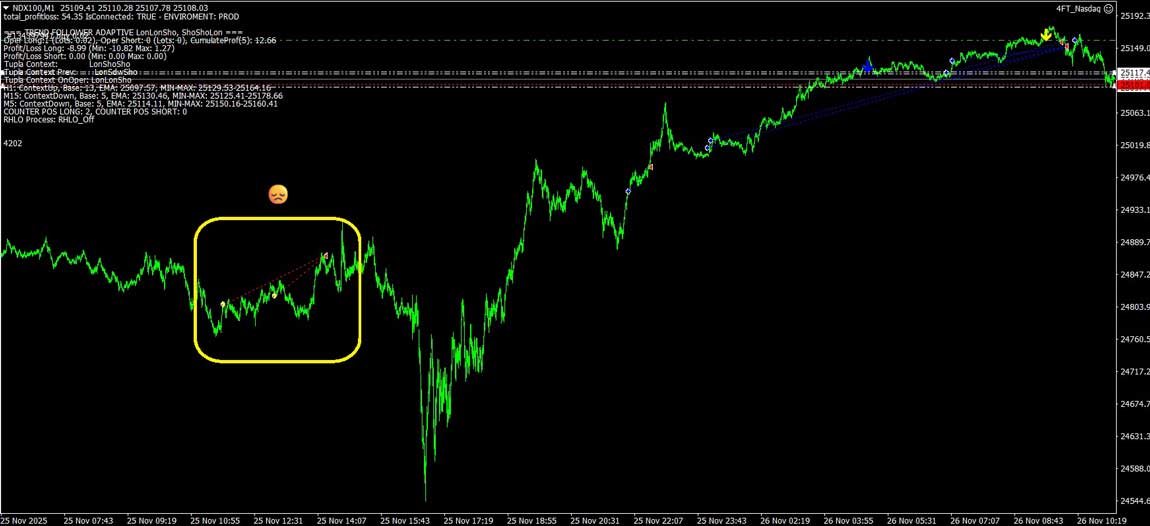
On November 25, price action settled in a lateral structure with unstable micro-expansions and limited directional conviction. The model identified two coherent short setups within that congestion. But once the market failed to confirm momentum, we closed both positions, keeping losses within predefined risk parameters.
Why this matters: when the market doesn’t confirm, the model does not chase an idea — it closes it. Discipline over conviction.
A “clean” long within the same lateral phase — and in profit
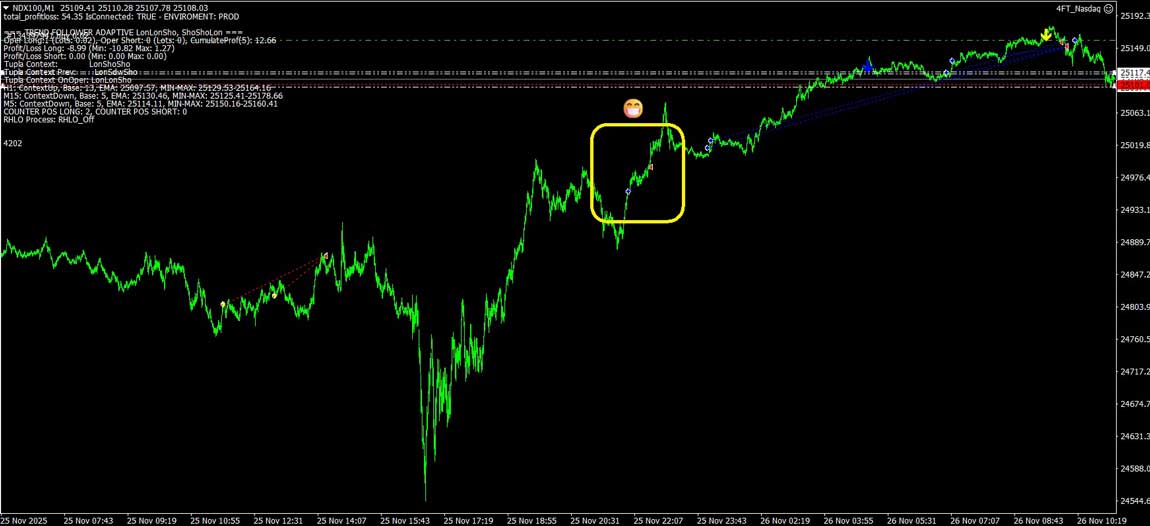
Later in the session, the market tone shifted: a small long-side expansion within the range showed a change in pressure. The model detected this shift, entered long, and the move followed through until the session close, producing profit.
A clear example that even within a range, when the pattern changes, disciplined and timely execution pays.
Overnight uptrend + 4 long trades = maximizing the move
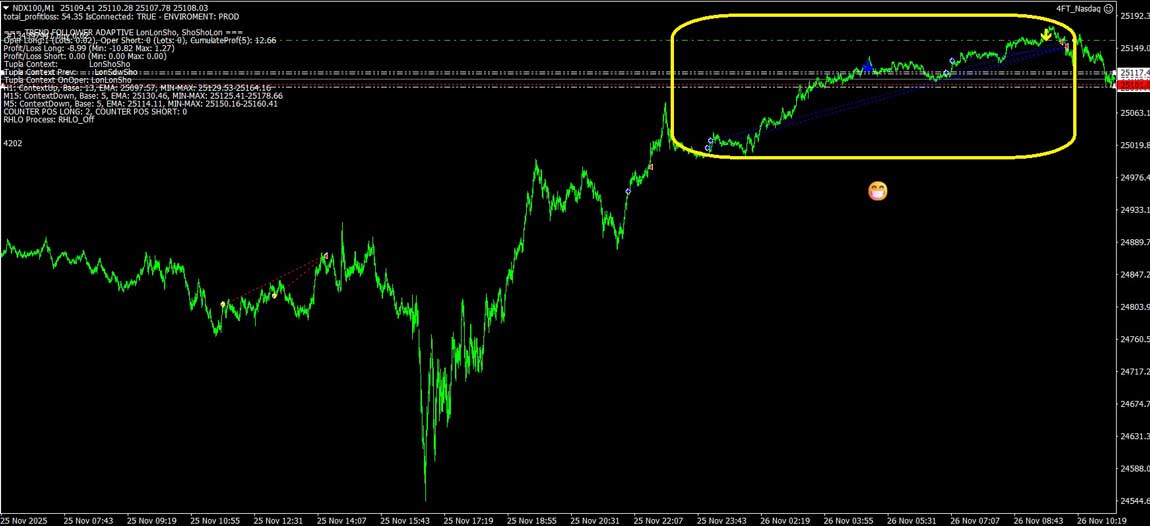
During the night — with the Asian session open and a clean breakout of the range — the market turned into a structured uptrend. The model recognized the shift, opening four long trades in sequence, all managed with dynamic trailing stops. By morning, all four trades closed in profit, capturing the core of the trend.
This shows the model’s flexibility: you don’t need to be “glued” to the market — you must be ready to engage when the context changes, with clear criteria.
Why a disciplined approach like 4FT Invest makes the difference
• It’s not about intuition or luck, but about method: context reading, pattern detection, risk management.
• It allows effective trading in both range-bound and trending markets: the same framework adapts dynamically.
• It reduces emotional impact, avoiding over-trading — if the model sees no confirmation, it exits; if the context shifts, it exploits it.
• Over time, it builds a repeatable, professional discipline, independent of market direction.
How the macro and monetary environment may impact Nasdaq in the medium term
If the Fed proceeds with further rate cuts as expected into December and potentially in 2026, this could result in:
• renewed risk appetite, benefiting growth and tech sectors;
• increased interest in companies with strong medium-long term growth prospects;
• higher volatility — but also greater opportunities for flexible, disciplined strategies (range, breakout, trend).
In such a scenario, an approach like 4FT Invest — flexible, systematic, and risk-aware — becomes particularly effective, as it is built to adapt quickly to context changes, protect capital, and leverage structural price movements.
In Summary
The Nasdaq is currently in a phase of significant transition: between macro fears, expected Fed cuts, and tech-sector opportunities, the market remains highly sensitive to rates, liquidity, and economic data.
In this environment, what truly makes the difference is not predicting the future with certainty, but having a method: measuring context, recognizing patterns, managing risk, and adapting.
This is the operating system of 4FT Invest. And with this disciplined approach, it’s possible to trade consistently and successfully — in ranges, in trends, and in uncertain markets like the current one.
© 4FT Invest LTD. All rights reserved
