
Markets under scrutiny amid volatility, macro risks, and growth opportunities for savvy investors.
Nasdaq, hi-tech and markets: the spotlight on uncertainty and opportunities
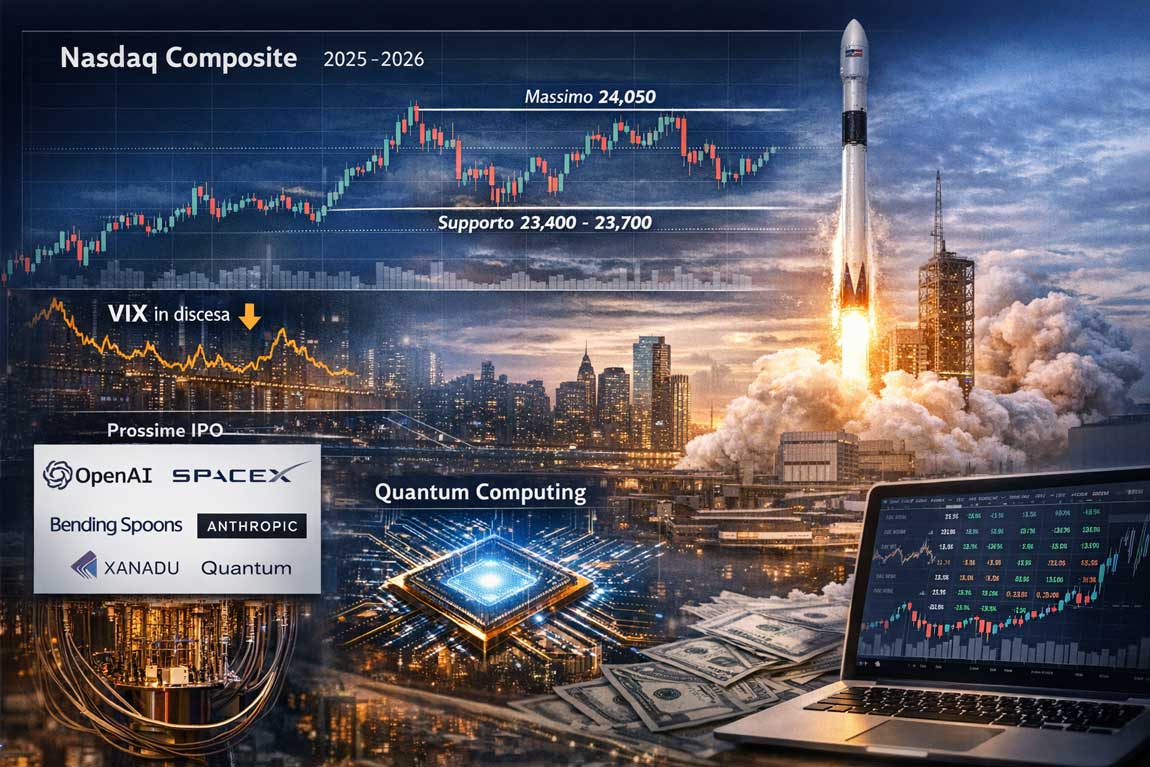
In 2025, the Nasdaq Composite— the main benchmark for technology stocks in the United States—recorded an overall positive performance, closing the year with an annual gain of around +20.3%, after fluctuating between very high levels and phases of sideways consolidation in the latter part of the year.
After reaching all-time highs in the autumn (above 24,000 points), the index entered a sideways phase at the end of 2025 and the beginning of 2026, with movements around the 23,400–23,700 range, as reflected in January 2026 quotations.
At the same time, volatility indicators—such as the VIX, often seen as a “thermometer of market risk”—showed pronounced spikes during the year, reflecting uncertainty linked both to monetary policy and macroeconomic concerns. Toward year-end, the VIX fell below key alert thresholds, closing under the peak levels reached in previous months, a sign of increased investor confidence heading into 2026.
This market oscillation, characterized by rallies and phases of price compression, was influenced by mixed economic data, interest rate policies, and sector-specific dynamics. Overall, however, technology and high-growth stocks led the recovery, supported by solid earnings prospects and investments in artificial intelligence.
2026: hi-tech IPOs, AI, and quantum computing — where investors are looking
The new listings front: expected IPOs and megatrends
2026 is shaping up to be a potentially important year for major technology IPOs. According to various market forecasts, leading hi-tech companies are preparing for IPOs or public listings with potentially significant proceeds. Among them are OpenAI, SpaceX, and Anthropic, with SpaceX possibly attempting a record offering of over $30 billion—well above the largest IPOs in history.
While OpenAI is targeting a listing in the second half of 2026, Anthropic has discussed IPO plans for the same year, fueling renewed investor interest in the artificial intelligence sector.
Other names linked to advanced technology ecosystems, such as BendingSpoons and Dataiku, are also attracting attention from investors and venture capital, although their listing plans are not yet fully defined.
Quantum computing: from niche to strategic
The new cycle of technological growth increasingly highlights quantum computing, a sector that promises to revolutionize computing capabilities in critical fields such as pharmaceuticals, finance, and AI. Companies like Quantinuum have announced formal IPO plans, signaling the sector’s maturation and the interest of major institutional investors.
Across the world’s leading stock exchanges, two main groups can already be identified:
Here, quantum represents a growth option rather than a binary bet.
Despite quantum computing still being at an early stage of commercialization, the growing attention from major technology groups and institutional investors points to potential structural growth for stocks linked to this technology.
Money management: strategy and technology for an uncertain market
In the current market environment—where volatility and rapid price changes are the norm—a solid money management discipline is crucial to preserve capital and seize opportunities. Risk management strategies that include stop-loss rules, position sizing, and diversification are not merely theoretical; they are decisive for long-term performance, especially in high-volatility sectors such as technology and AI.
In this context, automated money management systems, such as Expert Advisors (EAs) for platforms like MetaTrader, can offer significant advantages. Based on programmed algorithms, these EAs can:
Key features of well-designed money management EAs include dynamic leverage control, optimization based on historical and current volatility, and customizable risk/reward settings to suit different investor profiles.
These tools are not magic: they require backtesting, periodic monitoring, and a solid understanding of one’s own risk tolerance. However, when integrated into a disciplined investment plan, they can help improve operational consistency and reduce human error—especially in complex, high-growth technology markets.
For traders interested in exploring EA solutions for MetaTrader with robust automated money management modules, a selection of tools is available on 4ftinvest.com, covering various algorithmic management strategies tailored to different risk profiles.
In summary
Overall, the Nasdaq—and more broadly the U.S. hi-tech sector—enters 2026 from a position of strength but with mixed signals calling for caution. A strong rally in 2025 has been followed by a sideways phase that highlights uncertainty, while the prospect of major new IPOs and the development of disruptive technologies (AI and quantum computing) could offer significant investment opportunities. In this environment, a strategic approach that integrates disciplined money management and advanced automated tools can represent a competitive advantage for dynamic investors.
© 4FT Invest LTD. All rights reserved
