
Stocks, bonds, and funds can become tokens. Has the real game just begun?
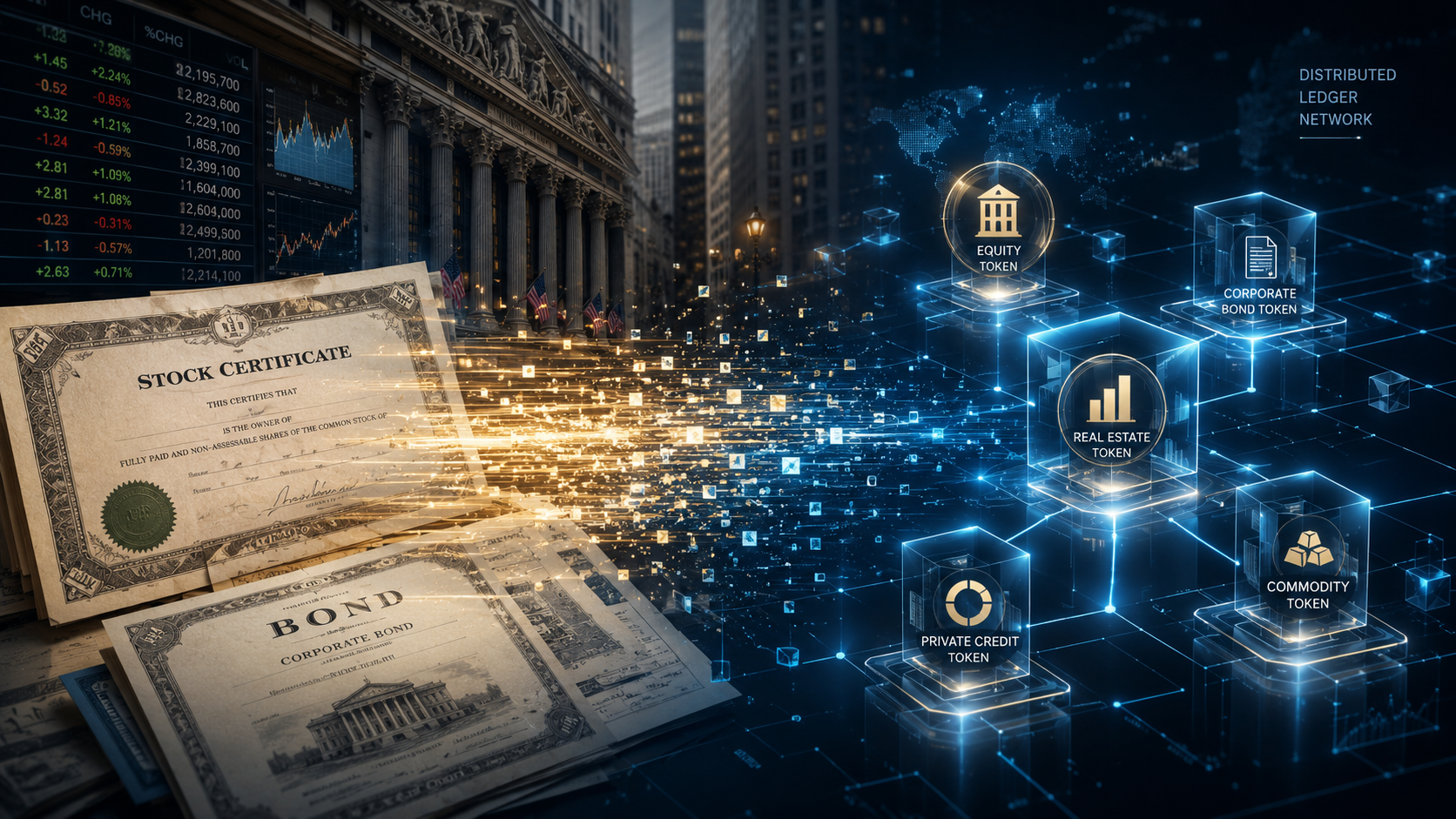
For decades, we imagined the Stock Exchange as a physical place: men in suits shouting orders, screens filled with numbers, bells marking the opening and closing of the markets. Then finance became electronic. Paper certificates were replaced by digital records, orders moved from telephones to online platforms, and trading entered the apps of everyday investors.
Now, we are talking about a new step: the tokenization of securities. It is an expression that may sound complicated, almost reserved for industry insiders, but it actually describes a fairly simple idea: representing traditional financial instruments, such as stocks, bonds, or fund shares, through digital tokens recorded on a blockchain or on a similar technology known as DLT, Distributed Ledger Technology.
This does not necessarily mean turning the Stock Exchange into a crypto casino, nor does it mean that tomorrow all shares will be traded like Bitcoin. Rather, it means using a new technological infrastructure to record, transfer, and manage financial instruments that already exist.
A tokenized security is, in simple terms, a digital representation of a financial asset. If we buy a share today, we no longer receive a paper certificate: our ownership is recorded by intermediaries, custodians, and market infrastructures. With tokenization, that record can exist on a shared digital ledger, updated in a synchronized way among multiple participants.
The innovation is not simply “putting a security on a blockchain.” The real difference is that the token can incorporate certain operational rules: transfer, payment, ownership verification, distribution of coupons or dividends, and possible restrictions on circulation. In theory, part of the processes currently managed by several separate entities could become more automated.
ESMA, the European Securities and Markets Authority, defines tokenization as the digital representation of financial instruments on DLT or the issuance of traditional assets in tokenized form, with potential efficiency improvements in trading and post-trading processes. The European DLT Pilot Regime, applicable since March 23, 2023, indeed creates a framework to experiment with the trading and settlement of financial instruments on DLT, while preserving investor protection, market integrity, and financial stability.
The fundamental point, however, is to distinguish between two very different things: a true tokenized security and a token that replicates the price of a security. In the first case, the token actually represents a regulated financial instrument. In the second, we may only have a product that follows the performance of a stock, without giving the buyer the same rights as a shareholder.
This distinction will be decisive for the future of the sector.
Tokenization was not born today, but it is now entering a new phase. For years, it remained mostly a topic for fintech conferences, banking experiments, and pilot projects. Now, however, institutions, regulators, central banks, and major market players are beginning to move.
In Europe, the DLT Pilot Regime has paved the way for new DLT-based market infrastructures: trading systems, settlement systems, and platforms that combine both functions. The goal is not deregulation, but testing innovation within a controlled framework.
The ECB is also working on infrastructure. The Eurosystem’s Pontes project aims to connect market DLT platforms with TARGET services, enabling settlement in central bank money. The ECB has explained that Pontes will use a dual-settlement model and support delivery versus payment, meaning the simultaneous exchange of securities and money, one of the pillars of financial market security.
In the United States, the topic is accelerating in a different way. Reuters reported that the SEC is preparing an exemption to facilitate the trading of tokenized versions of stocks, including on crypto platforms, and that these tokens may not guarantee traditional rights such as voting rights or dividends. This is an important signal: tokenization is moving from the laboratory to a real regulatory discussion.
The first benefit of tokenization is the potential reduction of friction. Today, buying or selling a security appears instantaneous, but behind the app interface there is a complex chain: brokers, custodians, clearing systems, settlement systems, banks, controls, and reconciliations.
The token promises to simplify this chain. Not because it magically eliminates all intermediaries, but because it can create a more direct connection between ownership of the asset, transfer, and payment.
The second benefit is programmability. A tokenized bond could distribute coupons automatically. A tokenized fund could manage subscriptions and redemptions more quickly. An instrument used as collateral could be transferred or locked with fewer operational steps.
The third benefit is fractionalization. Some financial assets are currently difficult to purchase in small amounts, especially in private markets, less liquid bonds, or certain funds. Tokenization could make it easier to divide these instruments into smaller units, broadening the investor base.
The fourth benefit is operational transparency. A distributed ledger can make it easier to track transfers, ownership, and movements, reducing reconciliation errors between different systems.
That said, the benefit is not automatic. A tokenized market is useful only if it is liquid, regulated, interoperable, and secure. A token that can be traded 24 hours a day is of little use if there are no buyers, sellers, legal guarantees, and reliable infrastructures.
There is no shortage of concrete examples. The New York Stock Exchange announced a collaboration with Securitize to develop a platform dedicated to tokenized securities, with the goal of working on regulatory, operational, and technological standards for institutional-grade infrastructures. Reuters reported that NYSE and Nasdaq are increasing their efforts to convert assets such as stocks, bonds, and funds into blockchain-based tokens.
Another example is BlackRock’s BUIDL fund, tokenized by Securitize. In 2025, Securitize announced that the fund had surpassed 1 billion dollars in assets under management and that it was BlackRock’s first tokenized fund issued on a public blockchain. This is an interesting case because it does not involve a meme coin or a marginal experiment, but instruments closer to institutional finance.
These examples show one thing: tokenization is no longer just a crypto narrative. It is becoming a possible evolution of traditional financial infrastructure.
Here, maximum clarity is needed. When an investor hears about “tokenized stocks,” they might think they are buying a real Apple, Tesla, or Microsoft share in digital form. But that is not always the case.
In some cases, the token may actually represent a regulated financial instrument. In others, it may be a synthetic product that replicates the price of the underlying stock. In still others, it may be linked to a more complex structure, perhaps with a vehicle that holds the real assets and issues tokens to investors.
The difference is enormous. Owning a share means having certain rights: voting rights, dividends when distributed, corporate protections, information rights, and participation in the life of the issuer according to market rules. Owning a token that replicates the price of a share may mean only having economic exposure to its performance.
ESMA has warned that tokenized stocks may create a risk of misunderstanding for investors, because they often offer exposure to the price of a stock but do not make the buyer a shareholder of the underlying company. According to Reuters, the European authority also stressed that these instruments may offer continuous access and fractionalization, but generally do not confer shareholder rights.
The World Federation of Exchanges has expressed similar concerns about tokens that mimic stocks, highlighting risks linked to regulatory arbitrage, lack of transparency, custody, and the possible erosion of fundamental investor rights.
This will probably be one of the central issues of the coming years: it will not be enough to ask, “Is the security tokenized?” We will need to ask what that token truly represents.
The first risk is confusion. If a product is marketed as a “tokenized stock” but does not provide the rights of a stock, the investor may be led to believe they own something they do not actually own.
The second risk is legal. Finance depends on certainty: who is the owner? Where is the right recorded? Which law applies? What happens if the intermediary fails? What happens if the platform is blocked, hacked, or shut down by an authority?
The third risk concerns liquidity. The promise of an always-open market is fascinating, but a market open 24/7 is not automatically an efficient market. If volumes are low, spreads are wide, and participants are few, the price can become fragile.
The fourth risk is technological. Blockchain can reduce some problems, but it introduces others: custody of private keys, smart contract security, interoperability between different networks, protocol updates, and operational risks linked to platforms.
The fifth risk is fragmentation. If every bank, exchange, or fintech builds its own closed ecosystem, tokenization could create more silos instead of eliminating them. The ECB itself has highlighted the danger of non-interoperable networks and standards, which could fragment liquidity and limit competition.
Europe seems to be moving with a more cautious and institutional approach: first the regulatory framework, then controlled experiments, then possible expansion. The DLT Pilot Regime goes precisely in this direction.
The United States, on the other hand, appears more oriented toward rapidly enabling new market models, including through the involvement of crypto platforms and large private operators. This can accelerate innovation, but it also increases the need to clarify rights, responsibilities, and protections.
In both cases, the point will not be to choose between old finance and new finance. The point will be to understand whether tokenization can improve the existing infrastructure without weakening the safeguards that make markets reliable.
The tokenization of securities may not arrive as a loud revolution. It is possible that the most important change will happen behind the scenes: in settlement systems, custody, collateral management, funds, bonds, and private markets.
For the ordinary investor, at least at the beginning, the experience may look similar: buying, selling, and checking a portfolio through an app. But behind that app, the rails on which ownership, payments, and information travel may change.
This is where tokenization becomes interesting: not because it promises to replace the Stock Exchange tomorrow morning, but because it can make more efficient what today remains invisible to the public.
The question, then, is not whether all securities will become tokens. The question is which parts of the financial market truly need to become tokenized.
The tokenization of securities is one of those topics that deserves attention without giving in either to blind fascination or to automatic rejection. The history of technology teaches us that major transformations rarely arrive in the form in which they are first announced. They often begin with ambitious promises, go through a phase of excess, and then find their real place where they solve concrete problems.
In finance, caution is mandatory: we are talking about savings, rights, trust, and market stability. But it would be a mistake to ignore what is happening. If central banks, regulators, stock exchanges, and major asset managers are studying tokenization, it means the topic no longer belongs only to the crypto world. It belongs to the future of financial infrastructure.
We do not yet know how big this change will be. But we do know that it is worth watching closely.
© 4FT Invest LTD. All rights reserved
