
AI and oil separate winners from losers: tech Asia and Wall Street surge, while Europe and India pay the price of the geopoli
The Uneven Market Rally of 2026
AI and oil separate winners from losers: tech Asia and Wall Street surge, while Europe and India pay the price of the geopolitical shock
Indicative YTD performance as of May 10, 2026.
| Market / Index | Approx. YTD 2026 | Summary |
|---|---|---|
| KOSPI | +77% | Global leader: semiconductors, memory, AI, Korea re-rating |
| Nikkei | +25% | AI, weak yen, earnings and corporate reforms |
| Nasdaq | +12% | Tech megacaps, chips, data centers, earnings above expectations |
| FTSE MIB | +10% | Banks, energy, dividends and still-contained valuations |
| S&P 500 | +7% | Quality rally, but concentrated in technology and AI |
| CSI 200 / China A-shares | +5% | Stimulus and valuations, but growth remains fragile |
| Hang Seng | +2% | Selective recovery, held back by real estate and Chinese demand |
| DAX | -1% | Pressure on industry, energy and European rates |
| CAC 40 | -1% | Luxury and cyclical stocks less vibrant, margins under pressure |
| Swiss Market | -1% | Defensive stocks less rewarded in a selective risk-on rally |
| Sensex | -9% | India penalized by oil, the rupee and foreign outflows |
| Dollar Index | -0.4% | Dollar almost stable: still a safe haven, but not dominant |
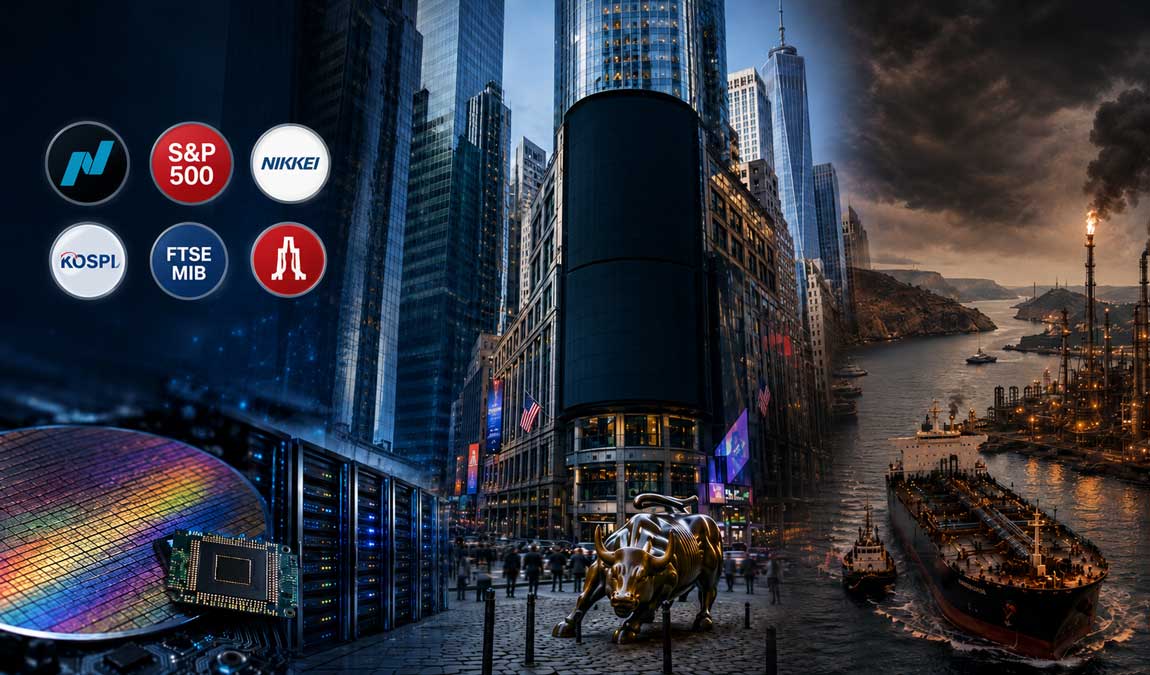
2026 is dividing global markets into two blocs. On one side are the stock markets tied to the artificial intelligence value chain — South Korea, Japan and the United States — which continue to capitalize on demand for semiconductors, memory, cloud infrastructure and data centers. On the other are markets more sensitive to oil, interest rates, currencies and domestic demand, such as India and continental Europe, where the Middle East crisis has reopened inflation risk and compressed valuation multiples.
The most spectacular case is South Korea. The KOSPI, up around 77%, has become the most aggressive barometer of the AI cycle: DRAM and NAND memory, server hardware and the supply chains of major hyperscalers have transformed Seoul from an undervalued “value” market into a global proxy for chip scarcity. Goldman Sachs estimates that hardware and semiconductors could drive a 300% increase in Korean earnings in 2026, thanks to sharply rising memory prices and structural AI demand.
Japan is the second major winner. The Nikkei, up roughly 25%, is benefiting from three factors: solid corporate earnings, enthusiasm for AI and semiconductors, and a weak yen, which continues to support part of exports and repatriated profits. Reuters reported that the Nikkei reached new records in early May, driven by technology earnings and expectations of de-escalation in the Middle East; J.P. Morgan also raised its year-end target for the Nikkei to 70,000, citing the AI boom and the weak currency.
Wall Street continues to rally because the U.S. market is pricing in a rare combination: robust earnings, an economy that remains resilient and technological leadership. The S&P 500 and Nasdaq reached new highs on May 8, supported by Nvidia, Micron, Sandisk and other AI-linked stocks; Reuters reported that 83% of S&P 500 companies that had published first-quarter results had beaten estimates, compared with a historical average of around 67%.
The reason the United States appears to be ignoring geopolitical risk is that the market is focusing more on earnings than on oil. S&P 500 earnings growth is being driven above all by technology, while the U.S. economy benefits from a still-solid labor market and an energy position very different from Europe, Japan and India: the United States is less vulnerable as a net energy importer and more credible as a financial safe haven. This does not eliminate risk; it concentrates it. The U.S. rally is powerful, but it depends heavily on a small number of stocks, on the AI narrative and on companies’ ability to pass on higher costs without eroding margins.
The Middle East crisis is the main external shock of 2026. The key flashpoint is the Strait of Hormuz: Reuters reported that tensions linked to the U.S.-Iran war have restricted maritime flows and pushed Saudi Aramco to make full use of the East-West pipeline, which has a capacity of 7 million barrels per day, to partially bypass the Gulf bottleneck. Brent crude has remained above $100 and had touched an intraday high of $115.30 during the most intense days of tension.
The impact is not uniform. The most affected markets are net energy importers: India, parts of Europe, Japan through its energy bill, airlines, chemicals, logistics and consumer discretionary sectors. India is the clearest case: the Sensex is down around 9%, the rupee is at record lows and foreign outflows are weighing on the market, because expensive oil worsens inflation, the trade balance, corporate margins and rate expectations. Reuters wrote that the rise in crude prices is negative for India, the world’s third-largest oil importer, because it fuels inflationary pressure and weighs on growth and earnings.
Europe sits halfway between the two extremes. First-quarter earnings are better than expected, but heavily distorted by energy: according to LSEG/Reuters, profits for European blue chips are expected to grow, but the contribution from energy majors is decisive, while revenue growth remains weak. This explains why the FTSE MIB, supported by banks, energy and dividends, is outperforming the DAX, CAC 40 and Switzerland, which are more exposed respectively to industry, luxury/cyclicals and defensive stocks that are less attractive in a global technology-led rally.
China remains an incomplete recovery. The Hang Seng and CSI are rising, but without the strength of South Korea, Japan or the Nasdaq. Low valuations and stimulus are helping, but the market continues to price in property-sector fragility, uneven consumer confidence and less vibrant growth. In other words, China is still a market for sector selection, not for a broad-based re-rating.
The dollar, almost flat since the beginning of the year, captures the cycle’s ambiguity well. On one hand, the U.S. currency retains its safe-haven role: Reuters notes that in the first quarter the dollar strengthened by around 1.6%, supported by the United States’ status as an energy exporter and the flight to liquidity. On the other hand, the greenback is not experiencing a super-rally because the market remains sensitive to deficits, trade policy, rate expectations and reserve diversification.
The most important risk for the second half of 2026 is that the oil shock becomes a monetary shock. According to Reuters, the Federal Reserve sees inflation still about one percentage point above its 2% target, with little likelihood of rate cuts in the short term; Austan Goolsbee described the shock so far as more “inflationary” than “stagflationary,” but warned that persistence would make it more dangerous.
The conclusion is that 2026 is not a year of global rally, but of extreme divergence. Markets that are monetizing AI, semiconductors, earnings beats and energy independence continue to generate profits. Those exposed to imported energy, weak currencies, higher rates and cyclical demand are retreating or struggling. The Middle East crisis has not stopped Wall Street because the U.S. market is buying future productivity; instead, it has hit those who have to pay today’s oil bill.
© 4FT Invest LTD. All rights reserved
