
War with Iran, Emotional Shocks and Market Volatility in Recent Weeks: The Advantages of Automation in Trading
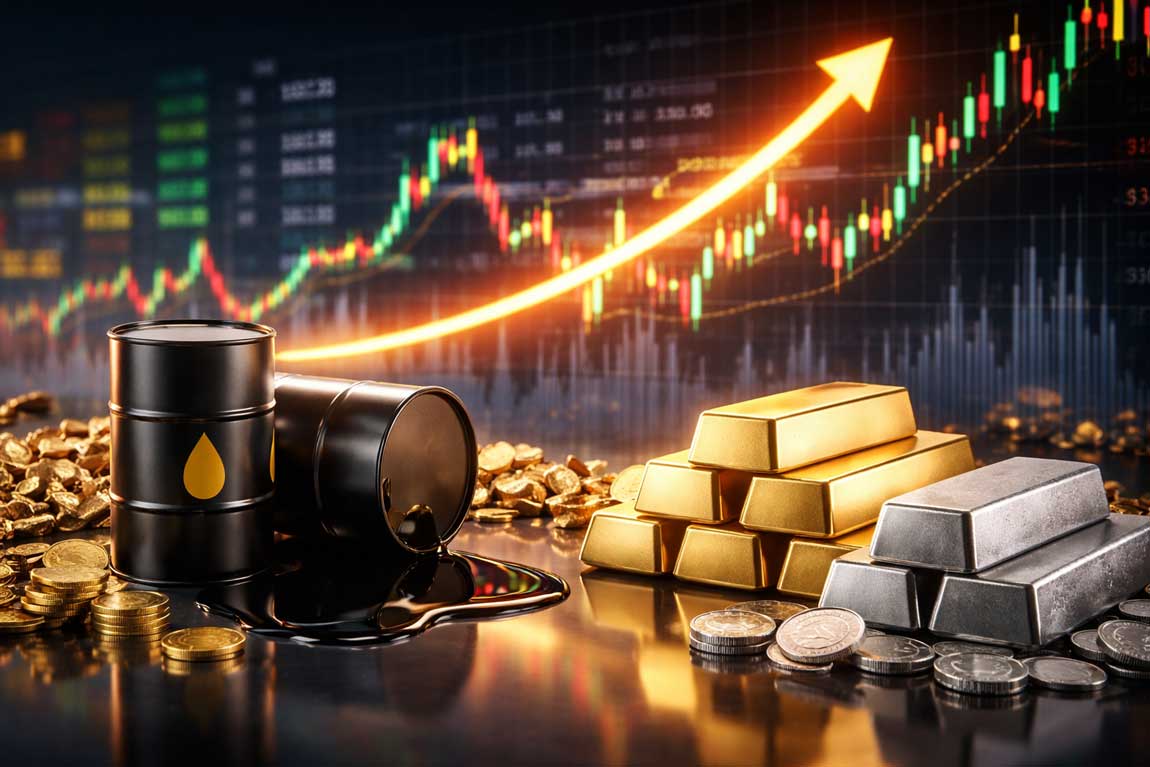
Commodities 2026: Oil, Gold and Silver Under Pressure
War with Iran, Emotional Shocks and Market Volatility in Recent Weeks: The Advantages of Automation in Trading
Over the past three weeks, the commodities market has entered a radically different phase. The transition from the late-February US–Iran tensions to the open conflict that began in early March has turned oil, gold and silver into assets driven not only by fundamentals but also by extreme emotional reactions, opening gaps, emergency hedging and constant revisions of expectations regarding inflation and central bank policies. Reports indicate that the conflict has now entered its second full week and that the closure of the Strait of Hormuz has disrupted a route through which roughly one fifth of global oil and LNG flows pass. Meanwhile, G7 governments and the International Energy Agency are discussing extraordinary measures to contain the energy shock.
Oil: Three Weeks of an Emotional, Non-Linear Market
The starting point is important. On February 24–25, before the real military escalation, Brent was trading around $70–71 per barrel and WTI around $65–66, with markets still oscillating between diplomatic hopes and fears of supply disruptions.
At the same time, shipping markets were already showing stress: freight rates for VLCC tankers from the Middle East had climbed to their highest levels since 2020, and data from market intelligence firms showed Middle Eastern crude exports exceeding 19 million barrels per day, highlighting how exposed the global system was to a potential shock in the Strait of Hormuz.
The real regime change arrived on February 28, when analysts began openly pricing a war scenario with an immediate geopolitical premium on crude. Early estimates suggested a $5–10 increase from a base around $73 per barrel, and in more severe scenarios Brent was projected to potentially reach $100 if regional security deteriorated further.
In other words, markets were no longer focusing on demand and inventories, but on the probability of rapidly losing a significant share of global supply or transport capacity.
The emotional peak occurred between March 8 and March 10. Oil surged roughly 20% in early trading on March 9, while Brent posted an intraday jump of up to 29%, pushing prices above $105 per barrel, levels not seen since 2022.
By the end of the session, however, part of the spike was reduced. Brent settled around $98.96, while WTI hovered near $94.77, as markets reacted to speculation about potential easing of sanctions on Russian crude and political signals interpreted as possible diplomatic openings.
This pattern is a classic example of a market dominated by emotion:
a violent opening gap, highs driven by fear of systemic supply disruption, followed by a rapid normalization not because the risk disappeared, but because traders began aggressively unwinding positions.
This dynamic explains why oil markets during wartime rarely move in a “clean” trend. The underlying driver remains bullish when markets fear supply cuts, logistical disruptions and production stoppages, but within that trend sudden pullbacks appear whenever even a hint of easing emerges, such as the release of strategic reserves or alternative supply flows.
Today the outlook remains sensitive to three variables:
Even before the conflict, the IEA estimated global oil demand growth of roughly 850,000 barrels per day in 2026, alongside a projected supply increase of 2.4 million barrels per day. However, these numbers may become secondary if geopolitical bottlenecks persist.
Gold: A Safe Haven, But Not in a Straight Line
Gold has also shown a particularly instructive behavior. In theory, during a war and energy shock environment, gold should act as the natural safe haven. In practice, during the first trading sessions after the attacks, markets favored the US dollar and liquidity instead.
Only three days after the initial strikes, gold experienced a sharp reversal, falling roughly 4% in a single day as the dollar regained its traditional safe-haven bid.
This highlights a crucial point: in acute crises, gold does not always move in a straight line. When energy prices surge, inflation expectations rise and the dollar strengthens, the precious metal can experience aggressive profit-taking or tactical liquidations.
Despite this, the medium-term trend remains strong. As of March 11, spot gold was still trading above $5,198 per ounce, with gains exceeding 20% since the beginning of the year and several new all-time highs recorded in previous weeks.
Support currently comes from a combination of:
In essence, gold today is driven by two engines:
However, if high energy prices and prolonged conflict push inflation expectations higher again, the US dollar could temporarily dominate, triggering further sharp corrections within an overall structurally bullish trend.
Beyond the war, long-term fundamentals also remain supportive. In 2025, central banks purchased approximately 863.3 tonnes of gold, a level still historically high and well above the average of the previous decade. This indicates that, even without the Iran shock, there is persistent strategic institutional demand supporting the market.
In the coming months, the balance will likely revolve around three forces:
If at least two of these remain supportive, gold could maintain a strong structure. If the dollar strengthens alongside rising real yields, however, volatility with deep pullbacks may continue.
Silver: More Explosive, More Fragile, More Interesting
Silver continues to confirm itself as the most volatile metal in the sector.
At the beginning of March, silver dropped as much as 10% intraday, during the same period when gold declined about 4%. By March 11, spot prices were still around $87.74 per ounce after a sequence of highly irregular trading sessions.
This behavior reflects silver’s hybrid nature: it is partly a precious metal and partly an industrial commodity.
When fear dominates markets, silver can rise alongside gold as a safe haven. But when liquidity tightens or fears of economic slowdown increase, silver often corrects more violently.
Looking ahead, fundamentals remain relevant. Industry forecasts suggest that global silver demand in 2026 will remain broadly stable, while the market may experience a sixth consecutive structural deficit, supported by a rebound in retail physical investment.
At the same time, roughly 60% of annual silver consumption is tied to industrial uses, including electronics, semiconductors and solar panels.
In market terms, this means silver has more beta than gold. If geopolitical instability persists but global growth does not collapse, silver could outperform. However, if the energy shock evolves into a broader macroeconomic slowdown alongside a stronger dollar, the metal remains exposed to deeper corrections.
What to Expect in the Coming Months
For oil, the key issue remains primarily logistical and political. As long as the Strait of Hormuz remains uncertain, the market will maintain a significant geopolitical premium, with sudden bullish spikes followed by equally sharp retracements driven by headlines, OPEC+ decisions, IEA announcements or developments in protected shipping corridors.
For gold and silver, the critical variables remain the interaction between geopolitics, the US dollar and Federal Reserve policy.
The more inflationary the conflict becomes, the more unstable the balance between safe-haven demand and pressure from real yields will be.
In such an environment, simply being correct about the trend is not enough. What matters most is managing the sequence of retracements, false breakouts and sudden accelerations.
Why Automated Trading Strategies Gain Value in This Environment
During highly emotional market phases, automated trading strategies offer a clear operational advantage.
They eliminate impulsive decision-making, maintain consistent execution, operate with predefined rules for entry, exit and risk management, and allow traders to navigate bullish trends, bearish phases and sudden pullbacks with greater discipline.
When oil can open with double-digit gaps or silver can reverse 10% within hours, discretionary traders often make classic mistakes: chasing the market or closing positions at the worst possible moment.
A well-designed automated system instead reacts to market conditions without being dominated by noise.
In this context, 4FT Invest provides retail traders with automated trading strategies designed for the MetaTrader 4 and MetaTrader 5 platforms, continuously updated to adapt to evolving market conditions.
The real value lies not in attempting to predict every move, but in applying a systematic trading logic across complex assets such as commodities, indices and forex, even during periods of intense geopolitical volatility.
Final Summary
Over the past weeks, oil has shown the purest form of a geopolitical risk premium: explosive rallies, fear-driven highs and pullbacks triggered by even the smallest signs of normalization.
Gold and silver remain structurally supported in the medium term, but volatility requires discipline, method and continuous adaptation.
It is precisely in these market phases that automated trading strategies can make a significant operational difference.
This content is for informational purposes only and does not constitute financial advice or an investment recommendation.
4FT Invest provides algorithmic trading technology and strategies; trading financial markets involves risk.
© 4FT Invest LTD. All rights reserved
