
Strong macro data amid uncertain global markets

European stock markets open higher
Strong macro data amid uncertain global markets
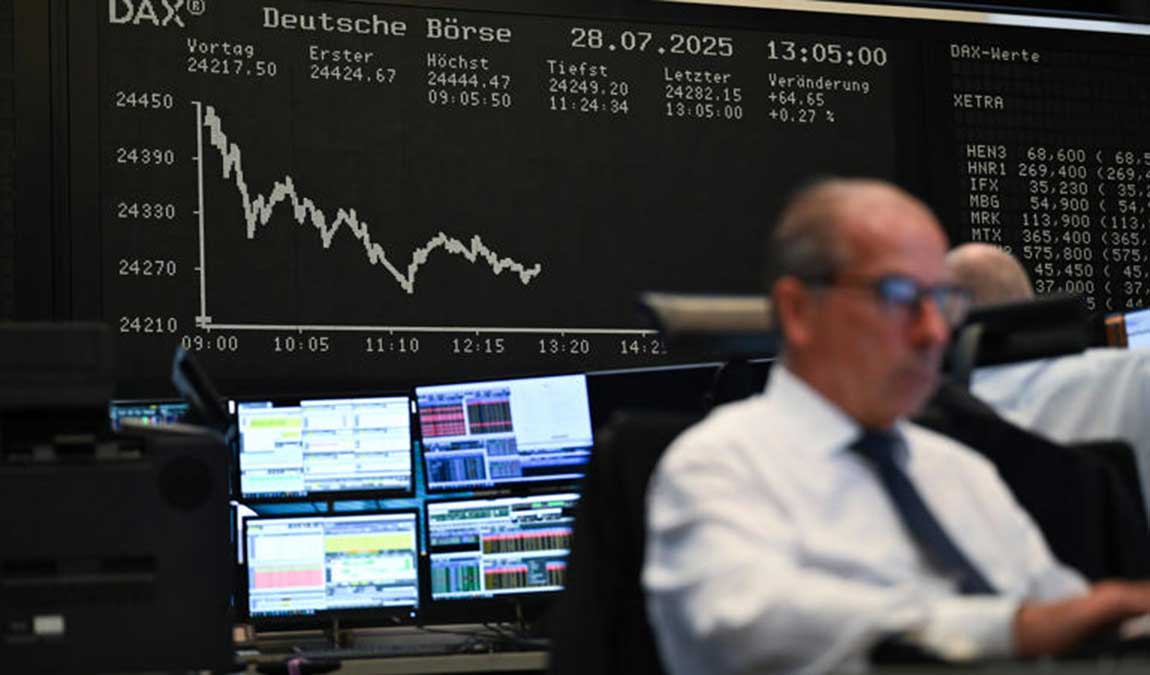
Today, the main European stock exchanges opened in positive territory, with London up +0.47%, Frankfurt +0.46%, and Paris +0.23% in early trading. This initial bullish tone reflects a combination of better-than-expected macroeconomic data and a general search for positive signals by investors, in a market environment still influenced by global risks.
Industrial production growth: a driver of sentiment
One of the key factors supporting today’s optimism is the update on industrial production in the euro area, released today.
According to Eurostat data, industrial production rose by 0.8% month-on-month (MoM), well above expectations of +0.3% and the previous reading of +0.2%. On a year-on-year (YoY) basis, it increased by 2.0%, also exceeding forecasts of +1.6% and the prior figure of +1.2%.
This improvement suggests that the European manufacturing sector is showing greater resilience than expected, strengthening investor confidence in the real economy and encouraging equity purchases at today’s open. More robust industrial production may translate into improved corporate earnings over the coming quarters and help ease fears of economic stagnation.
Why markets welcome industrial data
Industrial production data are among the most closely watched indicators because they reflect demand for goods, business activity cycles, and real output trends—crucial factors when interest rates are high and economic growth is moderate. A stronger-than-expected reading often leads investors to anticipate higher corporate profit growth, resulting in a more optimistic stance in equity markets.
Global outlook: gains, but risks ahead
Even as Europe opens higher, global markets remain shaped by macroeconomic risks and signs of slowdown. Several composite macroeconomic indicators—such as the 4FT Invest models, which are based on large economic databases like those of the Federal Reserve Bank of St. Louis (FRED) and integrate more than 25 statistical series—suggest that we may be approaching the end of the economic slowdown phase, with rising probabilities that the cycle could shift toward contraction or crisis. These indicators include variables such as industrial production, employment, consumption, manufacturing orders, yield curves, and other leading signals of economic cycles.
Historically, models of this type (including simpler ones based on recession indicators or yield curve signals) have been used to identify transitions toward recessionary phases in the U.S. or global economy. Currently, many of these signals point to a weakening of potential economic growth and activity expansion rates.
Other markets and global sentiment
In the United States and globally, equity indices have shown a degree of volatility in recent months, with mixed signals from key economic indicators (such as LEI indices and other monthly data), pointing to slower growth and an increased probability of economic deceleration in the coming quarters.
This mix of signals—strong economic data in Europe on one hand and rising global risks on the other—creates an environment in which equity markets can open higher but remain vulnerable to negative macroeconomic news or escalating international tensions.
In summary:
© 4FT Invest LTD. All rights reserved
