
Rates unchanged, guidance gone and a more hawkish dot plot: Nasdaq falls, gold turns volatile and yields rise.
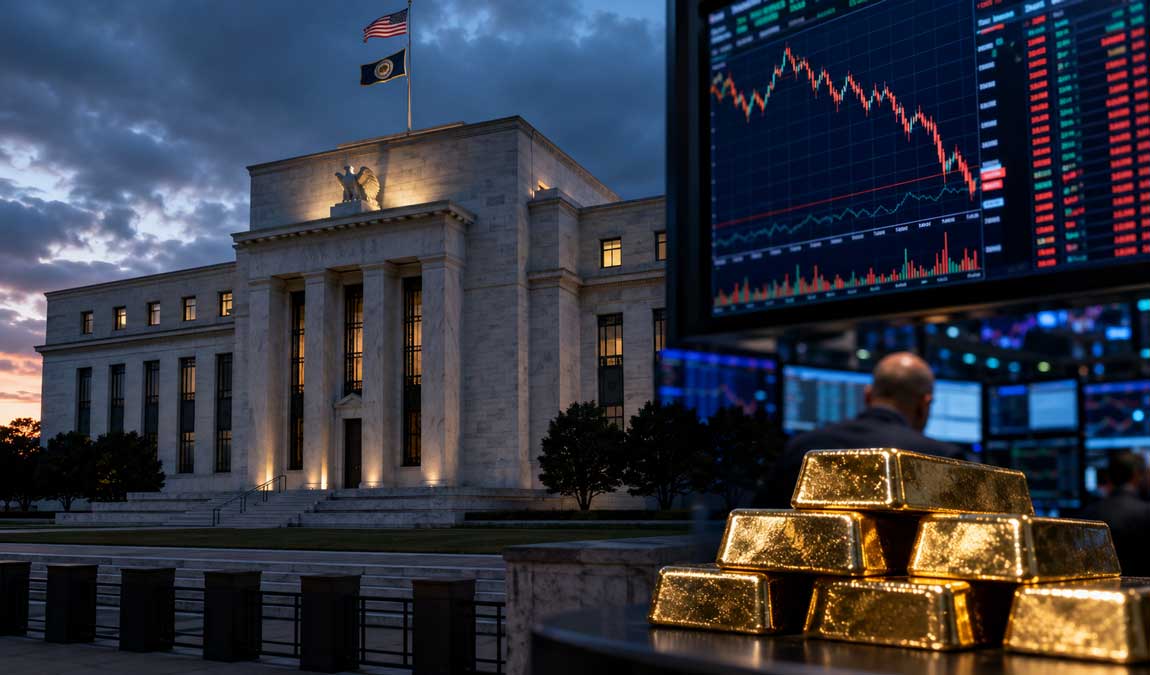
Kevin Warsh’s first real test at the helm of the Federal Reserve did not deliver a surprise on rates, but it did mark a clear break in language. At 8:00 p.m. European time, the FED left the Fed Funds target range unchanged at 3.50%-3.75%, exactly as widely expected. But markets were not looking for the rate decision itself. They were looking for direction, perspective and communication continuity.
That is where the regime change arrived.
The FOMC statement appeared very different from previous ones: shorter, drier, almost laconic. It was not simply concise; it seemed deliberately less focused on shaping expectations about the future. Forward guidance, the part of FED communication that for years helped investors interpret the likely path of interest rates, was effectively removed.
For financial markets, this is a significant development. In an already fragile environment, marked by still-elevated inflation, geopolitical tensions and sharp swings in energy prices, removing perspective means increasing the weight of incoming data and reducing the predictability of the central bank.
The formal message was simple: the U.S. economy continues to grow at a solid pace, the labor market remains resilient and inflation is still above the 2% target. But the real political and financial point was different: the FED no longer appears willing to guide markets step by step. It wants markets to price data again, not presumed central bank intentions.
Warsh’s press conference reinforced this approach. The only clear anchor remained price stability. Institutionally, that is a correct perspective. Operationally, however, it is vague. In the absence of explicit guidance, investors immediately turned to the dot plot, the individual rate projections of FOMC members.
That is where the picture became more restrictive.
Eighteen members expressed a projection for rates. Nine see at least one rate hike by the end of 2026. Some expect a total increase of 50 basis points, while one member indicates 75 basis points. Eight members see rates staying unchanged, while only one expects a cut. In other words, the FED did not raise rates, but it did raise the perceived risk surrounding the next move.
The new macroeconomic projections point in the same direction. The median estimate for 2026 PCE inflation rose to 3.6%, while core PCE is projected at 3.3%. Growth remains positive, though less robust than in previous estimates, with real GDP expected at 2.2%. The unemployment rate is projected at 4.3%, suggesting that, for now, the FED does not see enough labor market deterioration to justify a more accommodative stance.
The final message is therefore clear: the central bank has not tightened further yet, but it has removed the market’s assumption that the next move must necessarily be a rate cut. The narrative has shifted from “when will the FED cut?” to “could the FED be forced to hike again?”
Asset reactions were consistent with this shift in perspective.
Before the statement, the Nasdaq was trading in an uncertain but not clearly negative environment. In the previous days, lower oil prices linked to hopes of a de-escalation between the United States and Iran had supported sentiment toward risk assets. U.S. equities had benefited from the idea that lower energy pressures could reduce the need for further rate hikes.
After the statement, the scenario reversed. The Nasdaq Composite closed down around 1.3%, coming under pressure along with the rest of Wall Street. Rate-sensitive sectors suffered the most, because a possible return to tighter monetary policy reduces the present value of future earnings, hitting technology, growth stocks and companies with high valuation multiples in particular.
The 26,000-point area now becomes an important psychological level for the Nasdaq. Stabilization above this threshold would leave room for a possible recovery, especially if upcoming inflation data confirm a cooling trend. Conversely, a more decisive break lower could open the way to broader profit-taking, with the market forced to reprice rate risk and the duration of cash flows in technology companies.
Gold also experienced a significant move. Before the FED decision, the precious metal had been supported by lower expected real yields and geopolitical risk. Middle East tensions, the Iran dossier and uncertainty around energy markets had kept demand for protection high. Gold had also benefited from the idea that lower oil prices could make a new round of monetary tightening less likely.
After the statement, however, a stronger dollar and rising yields hit the yellow metal. Gold does not offer a coupon yield: when markets begin to price higher rates, the opportunity cost of holding it increases. The drop below the $4,300 area therefore reflected a classic reaction to a FED perceived as more hawkish.
The outlook, however, is less straightforward than it may seem. On the one hand, a more rigid FED and higher yields are an obstacle for gold. On the other, the metal remains supported by structural factors: central bank demand, geopolitical risk, currency uncertainty and the need for portfolio hedging. The $4,250-$4,275 area becomes a first zone to monitor, while above $4,300-$4,350 gold could once again attract defensive flows.
In the coming months, markets will focus mainly on three elements: core inflation, labor market data and energy prices. If PCE remains stubbornly above target and the labor market continues to show resilience, the FED would have room to maintain a restrictive stance or even consider another rate hike. If, instead, growth slows more visibly, the removal of forward guidance could become a double-edged sword: fewer public commitments, but also less visibility for investors.
In this new regime, volatility may remain elevated. Markets will no longer need to interpret only macroeconomic data, but also the FED’s new communication style. Fewer words do not necessarily mean less information. Often, they mean more uncertainty.
For traders and investors, this environment requires discipline, speed of interpretation and strict risk management. It is precisely in phases like this that algorithmic trading systems demonstrate their efficiency: not because they eliminate risk, but because they allow trading decisions to be based on predefined rules, fast execution and reduced emotional interference.
When markets move within minutes from orderly anticipation to violent repricing, the difference is not made by the perfect forecast. It is made by method, exposure control and the ability to adapt to real volatility scenarios.
© 4FT Invest LTD. All rights reserved
