
Digital assets are now driving global sentiment, influencing the Nasdaq, liquidity, and risk appetite
Crypto Take the Lead: April Redefines Markets
Digital assets are now driving global sentiment, influencing the Nasdaq, liquidity, and risk appetite
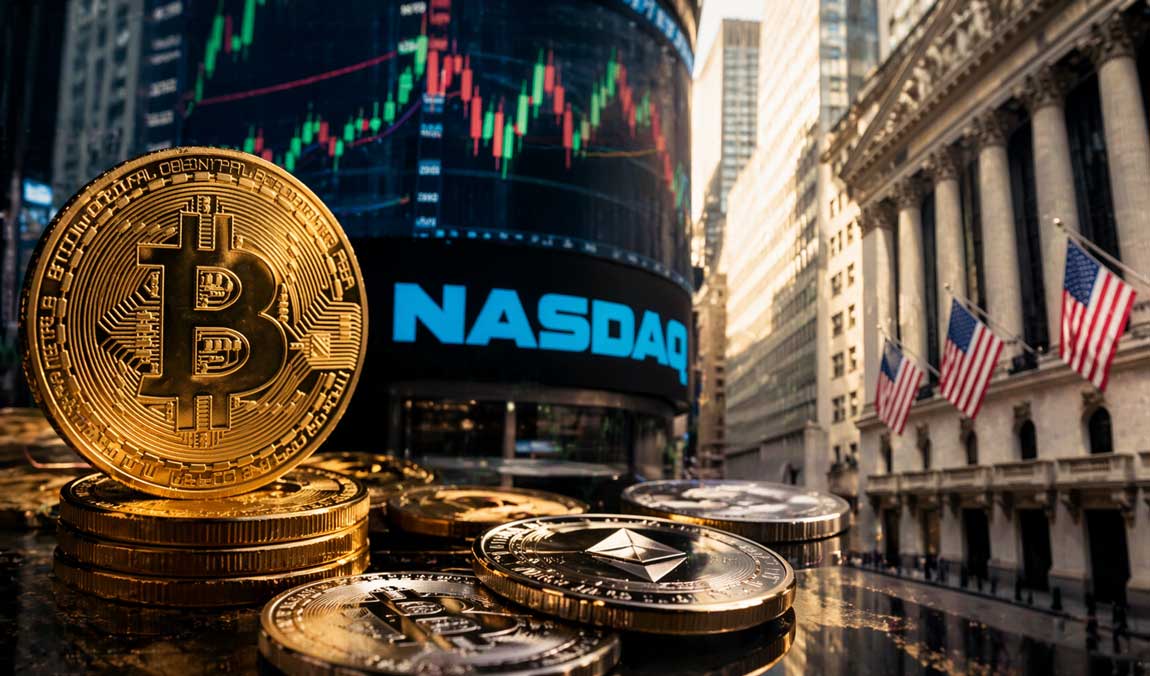
April 2026 will likely be remembered as a turning point in the hierarchy of financial markets. For years, the Nasdaq has served as the primary barometer of global risk, but a clear shift is now underway: sentiment is increasingly born in the cryptocurrency market and then spreads, with varying intensity, to traditional equities.
The performance of major cryptocurrencies throughout the month was emblematic of this transition. Bitcoin consolidated above the $60,000 level, building a solid technical structure characterized by higher lows and well-defined accumulation phases. Resistance in the $68,000–$72,000 range was tested multiple times, signaling sustained bullish pressure, supported by institutional inflows and renewed confidence in the crypto cycle.
Even more noteworthy was the behavior of altcoins. Ethereum demonstrated stronger relative performance compared to Bitcoin, while the broader altcoin market experienced a clear expansion. This pattern, typical of the later stages of a bullish cycle, was accompanied by a decline in Bitcoin dominance, indicating a rotation of capital toward more speculative—but also higher-performing—assets.
Within this context, the Nasdaq followed a consistent yet increasingly subordinate trajectory. After the weakness observed in March, the tech index regained ground throughout April, returning close to its historical highs. The move was largely driven by AI-related stocks and semiconductors. However, the index’s behavior appeared more reactive to developments in the crypto space rather than independently driven.
The correlation between the two asset classes strengthened further. During “risk-on” phases—characterized by rising liquidity and increased risk appetite—both cryptocurrencies and the Nasdaq moved higher in tandem. Conversely, episodes of macroeconomic or geopolitical uncertainty triggered synchronized pullbacks, highlighting a growing integration between traditional and digital markets.
April’s earnings season, particularly in the banking sector, helped stabilize the broader financial landscape. Overall earnings were solid, with S&P 500 companies posting estimated year-over-year growth of around 13%–14%. Banks benefited significantly from increased trading activity, in some cases reporting gains exceeding 30%, driven by heightened market volatility. This environment indirectly supported cryptocurrencies, fostering ample liquidity and active participation.
Despite this, equity markets—especially the banking sector—displayed more caution compared to crypto assets. Valuations remain tied to interest rate expectations and credit risk concerns, while cryptocurrencies continue to move more freely, driven by global capital flows and an increasingly independent narrative.
Geopolitical dynamics also played a meaningful role. International tensions and uncertainty surrounding monetary policy contributed to elevated volatility, while simultaneously enhancing the appeal of cryptocurrencies as alternative assets. In a world marked by instability and fragmentation, digital assets are progressively positioning themselves both as speculative instruments during expansion phases and as potential hedges in periods of systemic stress.
Looking ahead, the outlook remains constructive yet complex. Bitcoin holding above the $60,000 level is a key threshold for maintaining the bullish structure. A break above current resistance levels could open the door to further upside, particularly if accompanied by continued rotation into altcoins. At the same time, corrective phases cannot be ruled out, especially given the persistently high volatility and sensitivity to macroeconomic drivers.
April ultimately confirmed a growing reality for professional market participants: cryptocurrencies are no longer a peripheral market. They have become a central component of the global financial ecosystem—capable not only of reflecting sentiment, but increasingly of anticipating and, in many cases, leading it.
In this evolving landscape, understanding the dynamics of the crypto market is no longer optional—it is essential for accurately interpreting the direction of global markets.
Disclaimer: The information provided is for informational purposes only and does not constitute financial advice.
© 4FT Invest LTD. All rights reserved
