
Inflation, consumer spending, economic growth and labor data will reshape expectations for Federal Reserve policy and financi
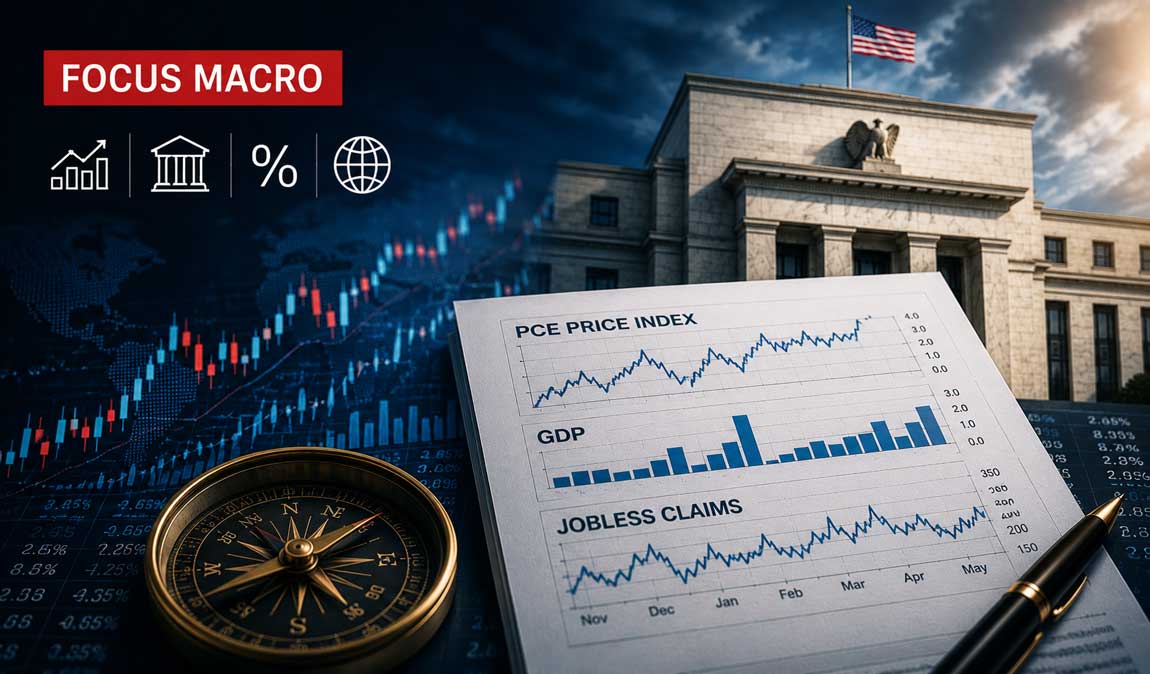
At 2:30 PM CET, global financial markets will face one of the most important macroeconomic releases of the month. At the same time, the United States will publish the latest figures on the PCE Price Index, personal income and spending, durable goods orders, the final revision of first-quarter GDP, and weekly jobless claims.
The focal point will undoubtedly be the Personal Consumption Expenditures (PCE) Price Index, the Federal Reserve's preferred measure of inflation. Markets expect headline PCE to accelerate to +0.5% month-over-month and 4.1% year-over-year, while Core PCE is forecast to rise 0.3% monthly and 3.4% annually. These figures are likely to have the greatest impact on Treasury yields, the U.S. dollar, the Nasdaq, and gold, as they will influence expectations for the Fed's monetary policy during the remainder of the year.
PCE Inflation: The Market-Moving Indicator
Should the PCE report come in above expectations, investors would interpret it as evidence that inflation remains persistent. In this scenario, Treasury yields would likely rise, the U.S. dollar could strengthen, and equity markets—particularly growth stocks and the Nasdaq—would come under pressure. Gold could initially weaken as higher real yields reduce its appeal, although persistent inflation concerns could later provide support.
A result in line with expectations would likely trigger an initial spike in volatility without establishing a clear market direction. Investors would then focus on the composition of inflation, paying particular attention to services, housing, and core price pressures. If higher inflation is mainly driven by energy prices, markets may view it as temporary. However, broad-based inflation across the services sector would reinforce a more hawkish Federal Reserve outlook.
Conversely, a lower-than-expected PCE reading would represent the most favorable scenario for both equities and bonds. Falling Treasury yields, a weaker dollar, renewed strength in the Nasdaq, and a positive environment for gold would likely follow as investors increase expectations that the Fed may eventually ease monetary policy.
Personal Income and Spending: Measuring Consumer Strength
Markets will also closely monitor personal income and personal spending, both expected to increase by approximately 0.5%.
If consumer spending remains robust while inflation stays elevated, the Federal Reserve would face an increasingly difficult challenge. Strong demand combined with persistent inflation would reduce the likelihood of policy easing later this year.
On the other hand, if consumer spending slows more sharply than expected, markets could interpret the data in two different ways. While weaker demand would help ease inflationary pressures, it could also signal a slowdown in economic growth. In that case, Treasury bonds would likely benefit, cyclical sectors could underperform, and technology stocks might outperform if declining yields become the dominant market driver.
U.S. GDP: Resilient Growth or Early Signs of Weakness?
The final revision of first-quarter U.S. GDP is expected to show annualized growth of approximately 1.7%, slightly above the previous estimate of 1.6%.
A stronger-than-expected reading would reinforce the narrative that the U.S. economy continues to withstand high interest rates. While supportive for the U.S. dollar, such a result could pressure equities and bonds if accompanied by elevated inflation.
A weaker GDP figure would ease pressure on the Federal Reserve but could also revive fears of stagflation if inflation remains stubbornly high. Slowing growth combined with persistent inflation would represent one of the most challenging scenarios for financial markets.
Durable Goods Orders: A Window into Business Investment
Durable goods orders are expected to decline following April's exceptionally strong performance. Consensus forecasts point to a 4.0% monthly contraction after April's 7.9% increase, which was largely driven by transportation and aerospace orders.
A decline broadly matching expectations would be considered a normal correction. However, a significantly weaker result—particularly excluding transportation—would suggest slowing corporate investment and weaker industrial activity. This would likely weigh on industrial companies, cyclical sectors, and small-cap equities.
Conversely, stronger-than-expected orders would indicate that business investment remains resilient but could also reinforce expectations that the Federal Reserve will maintain restrictive monetary policy for longer.
Jobless Claims: Labor Market Still in Focus
Initial jobless claims are expected to remain near 225,000, while continuing claims are projected around 1.8 million.
Lower-than-expected claims would confirm that the labor market remains exceptionally tight, strengthening the case for the Fed to keep interest rates elevated.
Higher claims, however, would signal a gradual cooling in employment conditions. Such an outcome would likely support Treasury bonds and equities, at least in the initial market reaction, as investors anticipate a less restrictive monetary policy outlook.
Three Possible Market Scenarios
The most hawkish outcome would combine higher-than-expected PCE inflation, resilient consumer spending, stronger GDP growth, and lower jobless claims. Markets would likely price in "higher-for-longer" interest rates, pushing Treasury yields and the U.S. dollar higher while pressuring the Nasdaq, gold, and other risk assets.
The most bullish scenario for risk assets would feature weaker-than-expected inflation, moderate consumer spending, a gradually cooling labor market, and stable economic growth. This combination would support Treasury bonds, technology stocks, gold, and broader equity markets while weakening the U.S. dollar.
The most challenging scenario would be one of stagflation: inflation above expectations alongside weaker GDP growth, slowing consumer spending, and deteriorating durable goods orders. Such a combination would significantly complicate the Federal Reserve's policy decisions and could trigger widespread volatility across equities, fixed income, and credit markets.
Conclusion
Today's 2:30 PM macroeconomic release represents far more than a routine data update. It is a critical test of the market's dominant narrative: Is inflation proving persistent? Is the U.S. economy maintaining its resilience? And will the Federal Reserve be forced to remain restrictive for longer?
For investors, the key will not be any single figure but rather the interaction between Core PCE, consumer spending, GDP growth, and labor market data. Together, these indicators will determine the near-term direction of Treasury yields, the U.S. dollar, the Nasdaq, gold, and expectations for Federal Reserve policy during the second half of 2026.
© 4FT Invest LTD. All rights reserved
