
The 4FT model signals the end of the cycle: mixed data, cautious rates and liquidity return to center stage
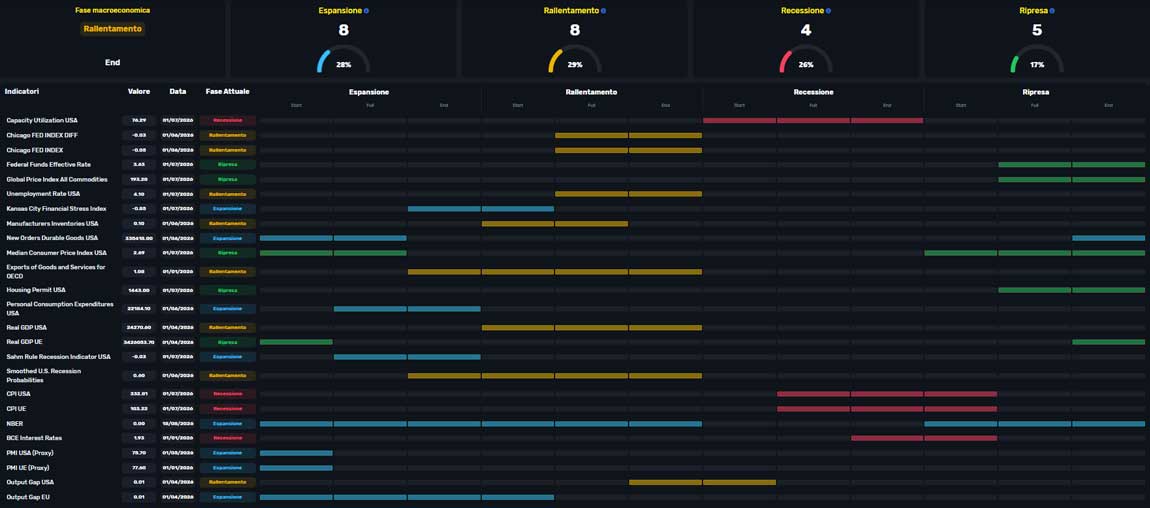
The latest update of the 4FT Invest Ltd macroeconomic model significantly changes the reading of the cycle compared with the analysis published on May 13. At that time, the picture pointed to a possible early expansion phase; today, after the update of the main indicators, the 4FT dashboard places the macroeconomic phase in a terminal slowdown, with an unstable balance between expansion, slowdown, recession and recovery.
This signal does not automatically mean that a recession is already underway. Rather, it indicates that growth is losing quality and breadth: some industrial indicators remain positive, but labor, consumption, inflation, credit and monetary policy suggest a much more fragile cycle. This is the phase in which the economy may still appear resilient in aggregate data, while margins, confidence, liquidity and risk appetite begin to deteriorate beneath the surface.
In the United States, real GDP in the second quarter of 2026 grew by an annualized 1.5%, slowing from 2.1% in the first quarter. Growth was supported by consumption, investment and exports, but was partly offset by the contraction in public spending and the increase in imports. Estimated a slowdown toward 0.9% by the end of the quarter, suggesting that the cycle’s momentum could weaken further.
The labor market is the data point that most supports the prudent reading of the 4FT model. In July, nonfarm payrolls fell by 23,000, while the unemployment rate remained at 4.1%. Labor force participation stood at 61.4%, down 0.7 percentage points since January, while the employment-population ratio fell by 0.5 percentage points. The data do not yet point to an employment crisis, but they show that the labor market’s ability to absorb shocks is weakening.
Consumption is also beginning to lose strength. US retail and food services sales in July stood at $763.6 billion, down 0.6% month-on-month, although still up 5.0% compared with July 2025. The detail matters: sales are not adjusted for inflation, so the real slowdown in demand could be more pronounced than the nominal figure suggests.
Inflation remains the central issue. US CPI in July rose by 0.1% month-on-month and 3.4% year-on-year, with core CPI at +0.2% month-on-month and +2.5% year-on-year. Energy fell by 1.5% during the month, but remains up 14.7% year-on-year, mainly due to gasoline, still up 24.6% from the previous year. This confirms that the energy shock has not yet fully worked its way out of the system.
The PPI offers an apparently more favorable reading, but not one without risks. In July, the producer price index for final demand was unchanged after a 0.1% decline in June; however, on a year-on-year basis it remains at 4.7%, while the component excluding food, energy and trade services rose by 0.4% month-on-month and 4.7% year-on-year. In other words, energy disinflation is helping the headline figure, but underlying cost pressures have not yet been resolved.
Manufacturing, meanwhile, continues to send mixed signals. The ISM Manufacturing PMI rose to 55.6 in July, its highest level since May 2022, with new orders at 56.7, production at 58.5 and employment at 52.8, returning to expansion for the first time in 33 months. However, the prices index remains very elevated at 71.1, and the report indicates that 62% of companies’ comments were negative, with price volatility, the war in Iran, lead times and tariffs among the main sources of pressure.
US industrial production confirms a degree of resilience, with the FRED INDPRO index at 102.9939 in July, above both June and May. Capacity utilization also rose to 76.2878%, but remains below levels normally associated with a fully robust industrial cycle. It is therefore a technical improvement, not necessarily proof of a broad-based expansion.
The global picture reinforces caution. The International Monetary Fund forecasts global growth of 3.0% in 2026 and 3.4% in 2027, but stresses that global disinflation has stalled and that risks remain linked to conflict, financial market repricing and divergences between economies exposed to energy and those supported by technology demand.
The OECD is even more explicit: under a prolonged “disruption” scenario, global growth could slow to 2.1% in 2026 and 1.8% in 2027, while inflation would rise and force central banks to balance price stability against support for growth. The World Bank, in turn, estimates global growth at 2.5% in 2026, with downside risks linked to energy, commodities, geopolitics, debt and tighter financial conditions.
In Europe, the situation remains fragile. In the second quarter of 2026, Eurozone GDP grew by 0.4% quarter-on-quarter and 1.0% year-on-year, but the improvement comes after a period of stagnation. Eurozone inflation rose to 2.9% in July from 2.8% in June, remaining above the ECB’s target.
China, meanwhile, is slowing, GDP growth of 4.3% year-on-year in the second quarter of 2026, below the 5.0% recorded in the first quarter and below expectations of 4.5%. Weak domestic demand, the property crisis and lower private investment momentum continue to weigh on the economy, while exports linked to technology and AI are not enough to offset domestic fragility.
For central banks, a terminal slowdown is the most difficult phase. The Federal Reserve kept its target range at 3.50%-3.75%, but the 9-3 vote reveals a significant internal split: three members would have preferred a 25-basis-point hike. The statement acknowledges that economic activity is expanding, but also that inflation remains elevated and reflects supply shocks, including energy.
The ECB left rates unchanged in July, with the deposit rate at 2.25%, the main refinancing rate at 2.40% and the marginal lending rate at 2.65%, reaffirming a data-dependent approach and making no pre-commitment to a specific rate path. The Bank of England also kept the Bank Rate at 3.75%, explaining that the conflict in the Middle East is keeping energy prices high and volatile and that inflation could rise again later in the year.
The central point is that the market is no longer in a phase where it can simply price in rate cuts and an earnings recovery. It must now assess a more complex balance: slowing growth, inflation still above targets, cautious central banks and a greater risk of downward revisions to corporate earnings.
Within this framework, the 4FT Invest Ltd reading appears consistent with a late-slowdown phase: a recession is not yet confirmed by official data, but the structure of the cycle is weakening. The most relevant signals are the loss of GDP momentum, the deterioration of labor market conditions, weaker real consumption, still-persistent inflation and the reduced room for maneuver available to central banks.
From a market perspective, this phase has historically tended to favor quality, liquidity and capital protection. Short- and medium-term government bonds, particularly in the 3-5 year area, may benefit from the search for safety without excessive exposure to duration risk. Investment-grade corporate bonds and covered bonds become more attractive than cyclical equities, as they combine higher credit quality with yields still above those of the safest sovereign bonds.
Gold, silver and safe-haven currencies such as the Swiss franc also remain assets to monitor. They do not provide perfect protection, but they tend to attract flows when geopolitical uncertainty, energy shock risks and distrust toward public debt and fiat currencies increase. On the equity side, selection becomes crucial: technology, innovation and AI may continue to outperform, but only among companies with resilient business models, visible cash generation and the ability to defend margins and investment.
The risk, as also highlighted by the BIS (Bank for International Settlements), is that the economy enters a phase in which fiscal policy, monetary policy and financial stability become increasingly interdependent. High public debt, more frequent supply shocks, sensitive bond markets and the AI investment boom make it harder for authorities to choose between growth, inflation and system stability.
The next data releases will therefore be decisive. The macro calendar points to expectations for July Core PCE at +0.3% m/m, headline PCE at +0.2% m/m and 3.7% y/y, the second estimate of US Q2 GDP expected at 1.5%, durable goods at +0.2% and personal spending at +0.3%. If these numbers confirm persistent inflation and slowing consumption, the 4FT signal of terminal slowdown would become stronger. If, instead, demand remains solid without renewed price pressure, the cycle could stabilize before entering recession.
The conclusion is that the macro picture has shifted from “fragile expansion” to “terminal slowdown.” It is not yet a scenario of outright recession, but it is a phase in which the margin for error is narrowing. For investors and companies, the priority once again becomes the one that characterizes mature phases of the cycle: preserve liquidity, reduce exposure to the most cyclical assets, select quality and wait for confirmation from the data before increasing risk.
ETFs and asset allocation: the search for quality
Within a terminal slowdown phase, the analysis of the ETF basket takes on a central role because it makes it possible to translate the macroeconomic reading into potential areas of relative outperformance. In a scenario marked by weaker growth, more selective credit conditions, inflation that has not yet fully normalized and cautious central banks, the most coherent instruments are those exposed to credit quality, controlled duration, liquidity and defensive sectors.
The first block of the basket is represented by ETFs on European covered bonds and guaranteed bonds. Instruments such as iShares € Covered Bond UCITS ETF EUR (Dist) and iShares Pfandbriefe UCITS ETF (DE) provide exposure to a bond segment that is generally more defensive than pure corporate credit. Covered bonds and Pfandbriefe, due to their structure and underlying guarantees, tend to be perceived by the market as higher-quality instruments during phases in which attention to issuer risk and banking system solidity increases.
A second group concerns short- and medium-term government bonds. This category includes iShares € Govt Bond 3-5yr UCITS ETF EUR (Dist), iShares € Govt Bond 3-7yr UCITS ETF EUR (Acc), iShares $ Treasury Bond 3-7yr UCITS ETF USD (Dist), iShares $ Treasury Bond 3-7yr UCITS ETF USD (Acc) and iShares $ Treasury Bond 3-7yr UCITS ETF EUR Hedged (Dist). The logic is clear: in the final stages of a slowdown, investors tend to reduce exposure to more cyclical assets and look for liquid bond instruments, with more manageable duration risk than very long maturities. The euro-hedged version may be interesting for those seeking to reduce dollar/euro currency risk, while the USD versions maintain direct exposure to the US currency.
The defined-maturity component, represented by iBonds ETFs, is also particularly relevant. Instruments such as iShares iBonds Dec 2027 Term $ Treasury UCITS ETF USD (Acc), iShares iBonds Dec 2027 Term $ Treasury UCITS ETF USD (Dist), iShares iBonds Dec 2029 Term $ Treasury UCITS ETF USD (Acc), iShares iBonds Dec 2029 Term $ Treasury UCITS ETF USD (Dist), iShares iBonds Dec 2028 Term € Italy Govt Bond UCITS ETF EUR (Acc) and iShares iBonds Dec 2028 Term € Italy Govt Bond UCITS ETF EUR (Dist) allow investors to build a more orderly maturity-based strategy, similar to a bond ladder. In a phase of uncertainty over the path of interest rates, this structure can help plan capital reinvestment and better control the portfolio’s time horizon.
The most diversified part of the basket consists of aggregate bond, ESG, supranational and green bond ETFs. Instruments such as iShares € Aggregate Bond ESG UCITS ETF EUR (Dist), iShares € Aggregate Bond ESG UCITS ETF EUR (Acc), iShares US Aggregate Bond UCITS ETF USD (Acc), iShares US Aggregate Bond UCITS ETF USD (Dist), iShares $ Development Bank Bonds UCITS ETF USD (Acc), iShares $ Development Bank Bonds UCITS ETF EUR Hedged (Acc), iShares € Green Bond UCITS ETF EUR (Dist) and iShares € Green Bond UCITS ETF EUR (Acc) offer broader exposure across government bonds, investment-grade corporate bonds, supranational agencies and bonds with environmental objectives. In an advanced slowdown environment, this diversification can be useful because it reduces dependence on a single issuer, one yield curve or one currency area.
The potential outperformance of this basket, however, depends on specific macroeconomic conditions. High-quality bond ETFs tend to benefit from an environment in which growth slows, risk aversion increases and the market begins to price in a future less restrictive monetary policy stance. Conversely, a new inflation shock or an unexpected rise in yields would penalize above all the instruments with higher duration. For this reason, in the current phase, selection between short maturities, intermediate maturities, hedged instruments and maturity-target strategies becomes more important than simple generic exposure to the bond market.
Alongside the bond component, a portfolio built to navigate the terminal part of the slowdown can include a targeted selection of defensive or countercyclical equity sector ETFs. In healthcare, instruments such as iShares S&P 500 Health Care Sector UCITS ETF, iShares MSCI World Health Care Sector Advanced UCITS ETF, Xtrackers MSCI World Health Care UCITS ETF and SPDR MSCI World Health Care UCITS ETF provide exposure to pharmaceutical companies, healthcare services, medical devices, biotechnology and major global healthcare groups. The healthcare sector has historically tended to show greater resilience during slowdown phases because demand for medical care, drugs and healthcare services is less tied to the economic cycle than consumer discretionary, industrials or financials.
Another segment to monitor is energy. ETFs such as iShares S&P 500 Energy Sector UCITS ETF, Amundi MSCI Europe Energy UCITS ETF, SPDR MSCI World Energy UCITS ETF and Xtrackers MSCI World Energy UCITS ETF may play a tactical role in the presence of geopolitical tensions, oil and gas supply shocks or persistently high energy prices. Energy is not a defensive sector in the traditional sense, but it can outperform when the market fears a renewed increase in energy costs or a deterioration in supply chains. More thematic and volatile, by contrast, is the use of ETFs linked to the energy transition, such as iShares Global Clean Energy Transition UCITS ETF, which may capture long-term structural trends but remains more sensitive to interest rates, growth valuations and industrial policies.
In summary, the analysis of the ETF basket confirms its consistency with a terminal slowdown macroeconomic phase: bond quality, short and intermediate maturities, covered bonds, Treasuries, euro government bonds, defined-maturity instruments, aggregate bonds and selective equity sectors such as healthcare and energy represent the areas most compatible with an approach focused on capital protection and the search for relative outperformance. The priority is not to maximize risk, but to build more resilient exposures while waiting for the cycle to confirm whether the slowdown will turn into a recession or stabilize before a new recovery phase.
Disclaimer
This article is for informational and macroeconomic analysis purposes only. It does not constitute financial advice, an investment recommendation or a solicitation to buy or sell financial instruments. The data cited may be subject to revision. Any investment decision should be assessed with a qualified adviser based on one’s individual risk profile.
© 4FT Invest LTD. All rights reserved
