
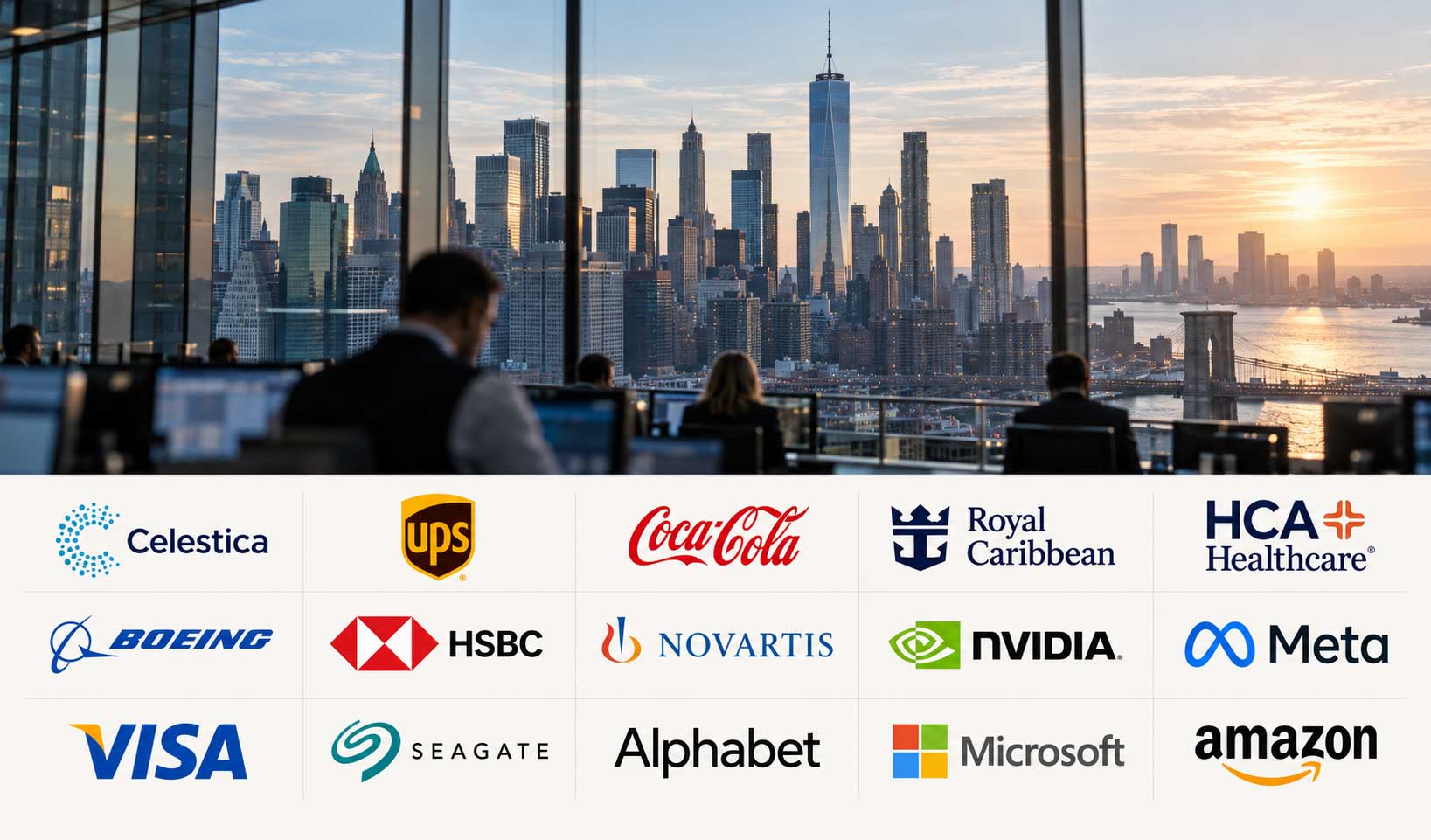
Celestica, UPS and Coca-Cola beat expectations, but guidance, margins, cash flow and geopolitical risk remain in focus
A solid aggregate picture, but the bar is rising
The U.S. earnings season points to robust growth, but investors are drawing a sharper distinction between beating estimates and the quality of the result. In FactSet’s October 23 report, when 24% of S&P 500 companies had reported, 83% had beaten earnings expectations—a share above historical averages. The aggregate earnings surprise, however, was 2.1%, below the five- and ten-year averages of 7.5% and 8%, respectively. FactSet also estimated revenue growth of 12.7% and a forward P/E ratio of 18.7 for the index, below the five- and ten-year averages. The picture is solid, but earnings quality, guidance and cash generation are driving share-price reactions.
The key results
Celestica: the strongest test of the AI supply chain. The data-center infrastructure supplier reported revenue of $5.83 billion, up 83% year over year, and adjusted earnings per share of $3.30, versus $2.96 expected according to LSEG. The company raised its 2026 outlook and forecast 2027 revenue of $40 billion, well above the market consensus of about $35.5 billion. The other side of the story is free cash flow: Celestica cut its 2026 forecast from $600 million to $460 million, citing working-capital investment to support growth. That signals very strong demand, but also serves as a reminder that growth must be financed and converted into cash. Shares gained more than 12% in pre-market trading.
UPS: an earnings beat backed by stronger guidance. Quarterly revenue rose 6.7% to $22.9 billion, against expectations of about $22.27 billion; adjusted EPS of $1.69 topped the $1.62 consensus. UPS raised its full-year revenue forecast to about $92.6 billion and adjusted EPS outlook to $7.28. GAAP net income, however, fell to $1.16 billion from $1.31 billion a year earlier. Restructuring, a reduction in lower-margin volumes and greater network automation are supporting operating quality, but revenue growth alone does not tell the whole story of profit trends.
Coca-Cola: volume and pricing support growth. The company reported revenue of $13.38 billion, versus expectations of $12.92 billion, and comparable EPS of $0.91, against $0.88 expected. Global unit-case volume grew 5%. Coca-Cola raised its forecast for comparable currency-neutral EPS growth to at least 9%, from a previous range of 7% to 8%. The results point to resilient demand, although favorable currency effects contributed and price/mix growth was more modest than volume growth.
Royal Caribbean: strong demand, with fuel and foreign exchange still in play. Adjusted EPS of $6.57 exceeded the company’s guidance, and the group raised its 2026 forecast to $17.85–$17.95 per share. The company attributed the result to robust demand, particularly close-in bookings, and lower costs due to timing. Fuel prices and foreign exchange, however, tempered the improvement in expectations—factors to watch across the travel sector.
HCA Healthcare: an earnings beat alongside a warning on insurance mix. Revenue rose 3.6% to $19.85 billion, and adjusted EPS of $7.22 exceeded the $6.66 estimate. HCA now expects full-year results to come in within the upper half of its previous guidance range. However, an increase in uninsured patients, partly tied to lost coverage in the health insurance exchanges, reduced quarterly pre-tax income by about $400 million. Outpatient surgeries also declined. The results show how reimbursement, health policy and patient mix can matter as much as volumes.
Boeing: positive cash flow, but the commercial division remains a constraint. The manufacturer reported a core loss of $0.34 per share, worse than the expected loss of $0.21, while revenue rose 4% to $24.19 billion. Free cash flow was positive at $0.5 billion and the order backlog reached a record $745 billion. But Commercial Airplanes reported an operating margin of -6.5%, pressured by delivery mix, production costs and supply-chain challenges. Progress on backlog and cash flow has yet to remove the risk around industrial execution.
Europe: profit growth is not enough
HSBC’s pre-tax profit rose 32% to $9.6 billion, in line with expectations. The market focused instead on revenue below consensus—$18.6 billion versus $19 billion—and flat revenue in its wealth division; shares fell 6% in London. Novartis raised its outlook for core operating profit despite a $1.9 billion write-down related to a clinical program. Revenue of $14.52 billion came in slightly below estimates, while core operating profit beat consensus. Together, the results show why earnings composition and the credibility of guidance matter alongside the headline figures.
Markets: tech gains, but broader participation remains to be seen
U.S. futures were higher ahead of the open, with the Nasdaq in front, after results from Celestica, UPS, Coca-Cola and Royal Caribbean. In the intraday snapshot at around 16:03 Italian time, the Nasdaq Composite was up about 0.3%, the S&P 500 was up 0.1%, and the Dow Jones was down 0.2%. The picture is consistent with a rotation toward growth and technology, but it does not yet amount to a broad-based rally. From a technical perspective, two positive sessions for the Nasdaq mark an attempted recovery; limited breadth and the Dow’s divergence are not enough to confirm a trend reversal.
For technology stocks, Celestica confirms demand for servers, networking and AI infrastructure. But the market is shifting its focus from spending alone to returns: high investment, the cost of capital and the time required to monetize AI will shape the value of future cash flows. Nvidia’s expanded partnership with Meta, including a $3 billion investment in Meta’s equity offering, has also revived debate about circular financing within the AI ecosystem. The next tests will be Visa and Seagate after the close, followed in the coming days by Alphabet, Microsoft and Amazon, with particular attention to capital-spending plans.
Geopolitical risk runs through energy and interest rates
The war in the Middle East remains a direct channel into energy prices, inflation expectations and bond yields. Reuters has linked uncertainty around the conflict to pressure on energy costs and the outlook for inflation and interest rates; today, a pullback in oil supported risk appetite at the Wall Street open. For travel companies such as Royal Caribbean, energy directly affects costs. For long-duration technology stocks, rising yields can compress valuation multiples. The Federal Reserve meeting, with its policy decision due Wednesday, adds another catalyst: a more hawkish message could offset the positive effect of strong quarterly results on valuations.
The provisional picture is constructive on fundamentals, but selective in its market response. Celestica, UPS and Coca-Cola show that growth remains real; Boeing and HSBC illustrate how the market can penalize weak margins, revenue shortfalls or guidance that fails to clear expectations. The Nasdaq’s ability to sustain its recovery will depend on results from the major hyperscalers, the conversion of AI investment into earnings and cash, and the cost of capital. Until the close and the next wave of reports, market moves remain a partial snapshot.
Disclaimer: This article is for informational and journalistic purposes only. It does not constitute financial advice, a solicitation to invest, or a recommendation to buy or sell any security. Data and prices refer to the times stated and may change; estimates and past performance are not guarantees of future results.
© 4FT Invest LTD. All rights reserved
