
Chips, data centers and investment returns: NVIDIA’s results will reveal how solid AI growth really is
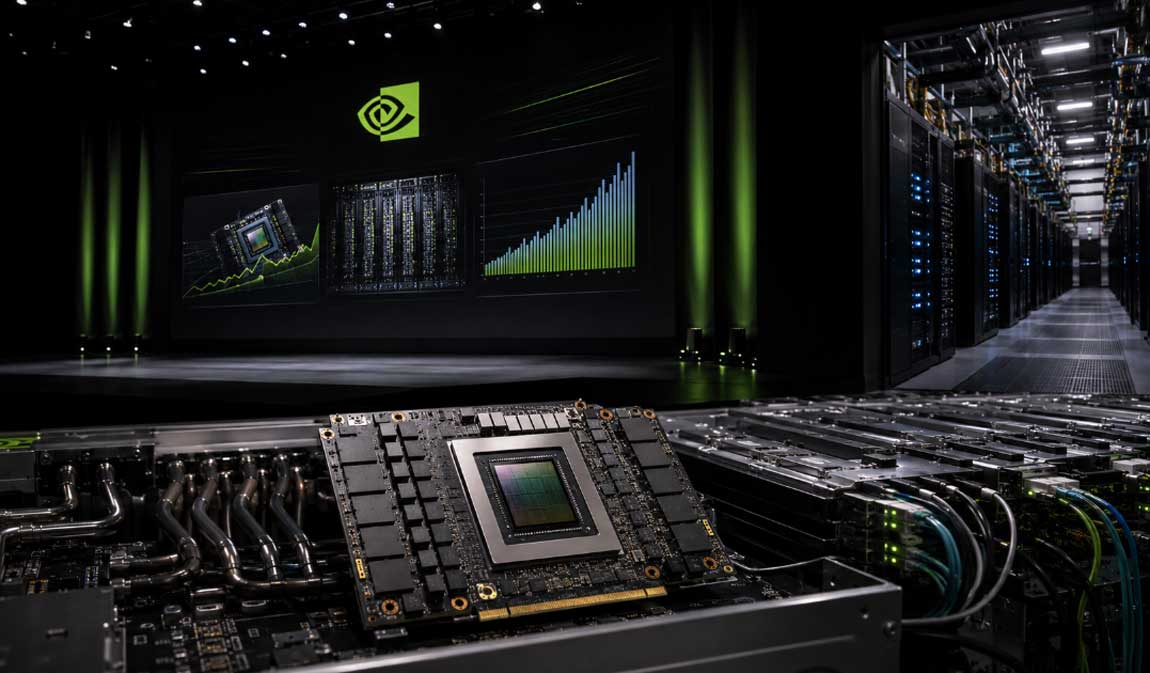
NVIDIA will release its fiscal 2027 second-quarter results today, August 26, after Wall Street closes. The conference call is scheduled for 2:00 p.m. Pacific Time, or 11:00 p.m. in Italy. More than a routine earnings report, the event represents a genuine stress test for the entire artificial intelligence ecosystem.
Investors will be looking for an answer to a question that has become critical: is AI growth producing sufficient economic returns to support the unprecedented investments being made by hyperscalers, corporations and governments?
The previous quarter: exceptional figures
In the quarter ended April 26, NVIDIA reported record revenue of $81.6 billion, up 20% from the previous quarter and 85% year over year.
Data Center generated $75.2 billion, an increase of 92% from the previous year, accounting for more than 92% of total revenue. Non-GAAP gross margin stood at 75%, while non-GAAP earnings per share reached $1.87.
The company also announced a new $80 billion share repurchase authorization and an increase in its quarterly dividend.
For the quarter being reported today, NVIDIA had provided the following outlook:
revenue of $91 billion, plus or minus 2%;
non-GAAP gross margin of approximately 75%;
non-GAAP operating expenses of approximately $8.3 billion;
no Data Center Compute revenue from China included in the forecast.
Market consensus subsequently moved towards approximately $92.4 billion in revenue and adjusted earnings of $2.10 per share. The options market is pricing in a move of around 5.4% in either direction, equivalent to a potential change in market capitalisation of approximately $280 billion.
Why the market did not fully reward the results
Despite record figures and guidance above official expectations, NVIDIA’s previous earnings report produced only a muted and slightly negative reaction in its share price.
This behaviour highlighted a shift in expectations: simply beating estimates is no longer enough for NVIDIA. Investors now expect acceleration capable of surpassing even the most optimistic unofficial forecasts while maintaining margins close to 75%.
The sensitivity extends far beyond NVIDIA. Disappointing guidance could affect semiconductor, networking and memory manufacturers, cooling-system companies and data-center power suppliers. Conversely, a forecast comfortably above $92 billion would strengthen the view that the AI infrastructure cycle remains far from maturity.
Five key revelations expected tonight
1. The real demand for Blackwell
The first indicator will be sequential Data Center growth and, in particular, demand for Blackwell systems.
The market will need to determine whether rising shipments reflect end demand that still exceeds supply or simply the fulfilment of accumulated orders. Guidance on the transition to Vera Rubin and NVIDIA’s ability to avoid slowdowns during the generational shift will also be important.
2. The balance between training and inference
Inference growth is probably the most important qualitative indicator. Training large models is concentrated among a limited number of operators and requires extremely high investment. Inference, by contrast, could generate more recurring and broadly distributed demand.
An acceleration in workloads linked to AI agents, search, video, robotics and enterprise applications would indicate that artificial intelligence is moving from model development towards large-scale monetisation.
3. The sustainability of margins
The 75% gross margin reflects pricing power, technological leadership and the strength of the CUDA ecosystem. NVIDIA’s ability to preserve it will be crucial.
Margin pressure could arise from the cost of new systems, the increasing complexity of rack-scale solutions, competition and the growth of custom chips designed by hyperscalers.
4. China and trade restrictions
The previous guidance did not include Data Center Compute revenue from China. Investors will look for updates on licences, products compliant with US restrictions, inventories and NVIDIA’s ability to compensate for the loss of this market through demand from the United States, Europe, the Middle East and the rest of Asia.
China remains both a commercial opportunity and one of the sector’s greatest geopolitical risks.
5. The economic return on AI capex
The real risk today is not a lack of investment, but the possibility that returns will take longer than expected to materialise.
Alphabet, for example, recorded second-quarter capex of $44.9 billion, largely directed towards technical infrastructure supporting AI. Google Cloud’s backlog climbed to $514 billion, signalling tangible demand, but quarterly free cash flow turned negative because of the intensity of these investments.
NVIDIA’s comments regarding orders from major cloud providers will therefore help investors understand whether this spending will continue to accelerate or enter a more selective phase.
The AI market beyond NVIDIA
The figures published by other companies indicate that the expansion is not limited to a single manufacturer.
AMD generated second-quarter Data Center revenue of $6.7 billion, up 107% year over year, driven by demand for EPYC processors and Instinct accelerators. It is NVIDIA’s most direct competitor and could benefit from hyperscalers’ need to diversify their suppliers.
Broadcom reported AI semiconductor revenue of $10.8 billion, an increase of 143%, supported by custom accelerators and networking products. The company represents one of the most significant exposures to the growth of ASIC chips developed for major cloud customers.
Marvell Technology achieved record quarterly revenue of $2.42 billion, of which $1.83 billion came from Data Center. Its growth is being supported by interconnects, optical solutions, switching and custom silicon.
These figures demonstrate how the competitive landscape is evolving. NVIDIA retains a dominant position in accelerated computing, while Broadcom, AMD and Marvell are gaining ground in custom chips, networking and alternative architectures.
Satellite companies to watch
Rather than selecting stocks on which to speculate indiscriminately, investors may find it more useful to build a watchlist covering different parts of the AI supply chain.
Vertiv: power and cooling
The rising density of data-center racks makes power infrastructure and liquid cooling indispensable components of AI factories. Vertiv raised its 2026 guidance, projecting revenue of $14 billion and organic growth of 31% at the midpoint.
It provides one of the most direct exposures to the physical bottlenecks affecting data centers. Its principal risks are a high valuation, manufacturing capacity constraints and a potential normalisation of orders.
Credo Technology: high-speed connectivity
Credo develops high-speed, energy-efficient connectivity solutions for AI clusters. In the third quarter of fiscal 2026, revenue reached $407 million, rising 201.5% year over year and 51.9% sequentially.
It is a smaller and potentially more dynamic company, but it also presents considerable volatility, demanding valuation multiples and customer concentration.
Astera Labs: connectivity inside the rack
Astera Labs operates in the semiconductor market for connecting GPUs, CPUs, memory and accelerators within AI platforms. The growth of rack-scale architectures increases the strategic value of PCIe, CXL and Ethernet connectivity.
The stock offers targeted exposure to the rising complexity of AI systems, but remains sensitive to its reliance on a limited number of customers and the rapid evolution of technology standards.
Marvell: optical technology and custom chips
Marvell could benefit from both the growth of chips designed specifically for hyperscalers and the expansion of optical connectivity. The company expects Data Center revenue to grow by approximately 50% in fiscal 2027, with interconnect revenue increasing by more than 70%.
It offers greater diversification than some small-cap companies, but must contend with competition from Broadcom and the execution risks associated with custom-chip programmes.
Coherent and Lumentum: the optical frontier
As clusters grow in size, data transmission is becoming as important a constraint as computing capacity. Coherent and Lumentum could benefit from the transition towards 800G and 1.6T optical connections.
These are more cyclical exposures, influenced by pricing, production capacity, customer concentration and the timing of new-technology adoption.
A hierarchy based on risk and quality
Among the most established companies, NVIDIA, Broadcom and AMD remain the principal reference points, thanks to their technological leadership, financial resources and greater capacity to absorb a potential slowdown.
Within the infrastructure segment, Vertiv and Marvell offer diversified exposure to energy and connectivity constraints.
Credo and Astera Labs offer stronger potential growth, but also carry significantly higher valuation, volatility and concentration risks. These stocks should be approached with more prudent position sizing and investment horizons consistent with their high level of uncertainty.
Outlook and major challenges
The fundamental outlook for AI remains expansionary: Data Center revenue at NVIDIA, AMD and Marvell is growing rapidly, Broadcom is accelerating in custom chips, and investment by major cloud operators continues to rise.
The challenges, however, are equally significant:
power availability and access to electrical grids;
cooling high-density clusters;
manufacturing capacity and advanced packaging;
export restrictions affecting China;
competition from proprietary hyperscaler chips;
the time required to monetise AI applications;
equity valuations that already incorporate exceptional growth rates;
the risk that capex will grow faster than the revenue generated by AI.
The verdict the market is waiting for
Results above expectations, accompanied by guidance comfortably exceeding $92 billion and stable margins, would confirm that the AI infrastructure cycle remains in full expansion. The entire supply chain could benefit, from semiconductors and networking to power and cooling.
Results that merely meet expectations may not be sufficient. Following such rapid growth, the market is valuing NVIDIA according to the distance between its actual figures and expectations that are already exceptionally high.
The most concerning signal would be a combination of weaker sequential growth, declining margins and greater caution among cloud customers. This would not necessarily demonstrate that an AI bubble is bursting, but it would indicate a transition from indiscriminate expansion to a phase in which orders, valuations and returns on capital will need to be assessed far more selectively.
Disclaimer: This content is provided exclusively for informational purposes and does not constitute financial advice or a solicitation to buy or sell financial instruments. The securities mentioned may be subject to high volatility and the risk of capital loss.

© 4FT Invest LTD. All rights reserved
