
Geopolitics, central banks and quantitative trading in the new volatility of the yellow metal
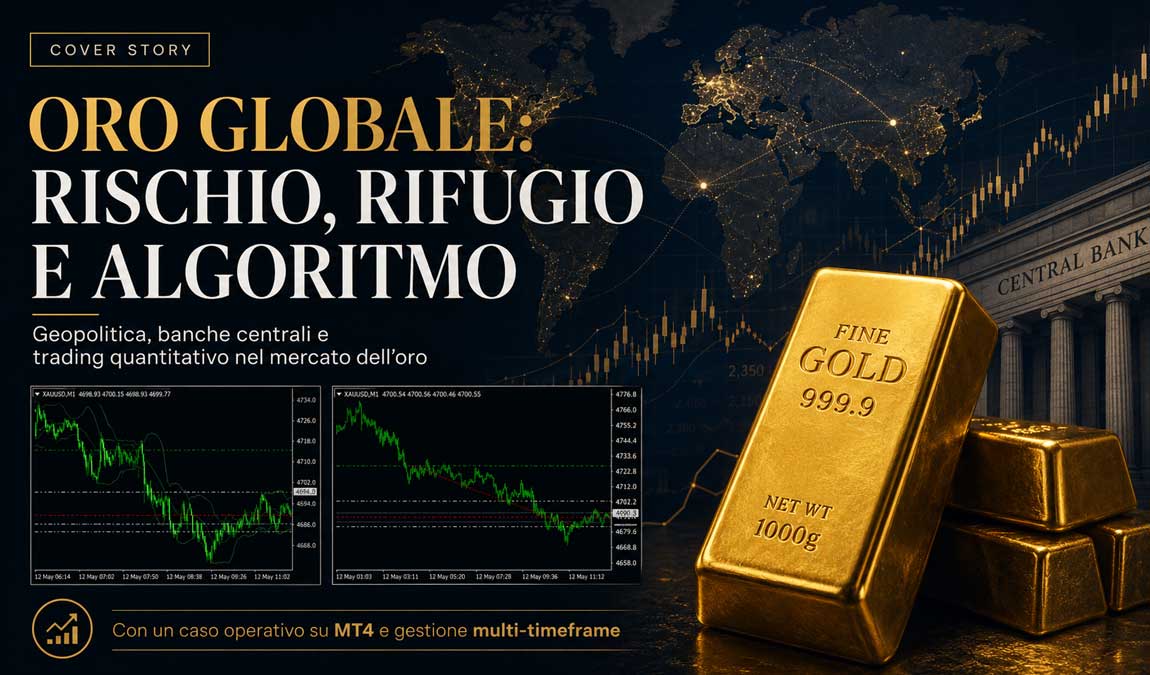
Global Gold: Risk, Safe Haven and Algorithm
Geopolitics, central banks and quantitative trading in the new volatility of the yellow metal
Gold has returned to the center of the global financial stage, no longer merely as a traditional safe-haven asset, but as a strategic asset at the crossroads of geopolitics, inflation, monetary policy, institutional flows and quantitative trading. Its recent dynamics describe a complex market: on one hand, structural demand remains supported by central banks and investors; on the other, intraday volatility is amplified by the dollar, bond yields, oil and speculative positioning.
In the first quarter of 2026, global gold demand, including the OTC market, rose by 2% year-on-year to 1,231 tonnes, generating a record value of 193 billion dollars thanks to the sharp increase in prices. The World Gold Council also reports that demand for bars and coins reached 474 tonnes, while gold ETFs recorded net inflows of 62 tonnes.
However, the market does not move in a straight line. Gold remains an asset with no coupon yield: when real yields rise and the dollar strengthens, downside pressure can emerge even in the presence of geopolitical tensions. On May 12, 2026, for example, Reuters reported a decline in spot gold toward 4,698 dollars per ounce, in a context of a stronger dollar, rising oil prices and uncertainty on the Middle East front.
Geopolitics remains the major accelerator. Regional conflicts, tensions on energy routes, trade fragmentation and confrontation between economic blocs are strengthening the risk premium embedded in the gold price. But the relationship is not mechanical: a crisis can support gold as a safe haven, or temporarily penalize it if it generates energy shocks, expected inflation, rising yields and a stronger dollar.
In this scenario, central banks have taken on a decisive role. In the first quarter of 2026, they purchased approximately 244 net tonnes of gold, with demand increasing compared with the previous quarter and exceeding the average of the last five years. This figure confirms that gold is still perceived as a strategic reserve, especially in a context of currency uncertainty, geopolitical instability and trust concerns within the international financial system.
This phenomenon did not begin in 2026. According to the World Gold Council, central banks have accumulated more than 1,000 tonnes of gold in each of the last three years, a pace significantly above the 400-500 tonne average of the previous decade. In addition, 95% of respondents to the WGC’s 2025 survey expected global gold reserves to increase over the following twelve months.
On the monetary policy front, the Federal Reserve kept the Fed Funds target range at 3.50%-3.75% in April 2026, reaffirming its objective of bringing inflation back to 2% and noting that developments in the Middle East contribute to a high level of economic uncertainty. The ECB also adopted a cautious stance, leaving its main interest rates unchanged in April 2026 and declaring a meeting-by-meeting approach, without pre-committing to a specific rate path.
The speculative component completes the picture. ETFs, futures, options and high-frequency trading make the gold market extremely sensitive to sudden flows. In March 2026, according to the World Gold Council, record outflows from global ETFs halved first-quarter inflows, while still leaving the quarterly balance positive thanks to strong Asian demand.
In this environment, traditional technical analysis remains useful, but it is not enough. Markets react within minutes to macro news, liquidity levels, stop clusters, implied volatility and cross-asset variations. For this reason, the ability to read price, context, trend, volatility and multiple timeframes simultaneously becomes an operational advantage.
The example shown in the two MT4 trading images, related to XAUUSD on the M1 timeframe, clearly represents this dynamic. In the first image, we can observe a sequence in which the algorithm initially opens a long position based on an apparently consistent technical setup: price reaction, intraday support area and an attempted recovery after a phase of bearish pressure. However, the market quickly changes context.
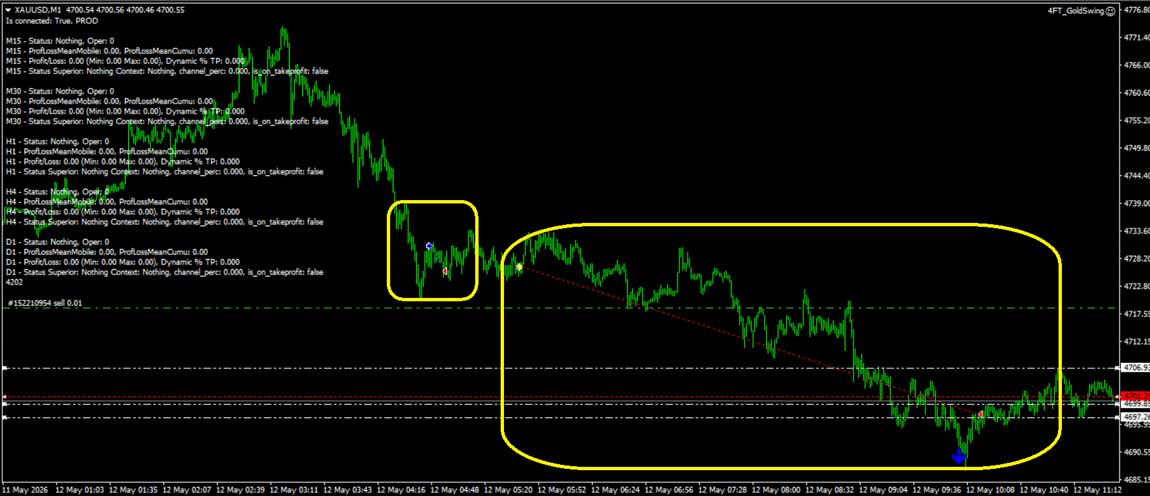
The system detects the deterioration of the bullish signal, closes the long with a contained loss and recalibrates the operational bias. The second trade, this time short, aligns with the new dominant structure: bearish momentum, price under pressure, a break of the previous micro-structure and continuation of the move. The initial error is not amplified, but transformed into operational information.
The second image adds a further level of analysis: a third trade still open and under management during the same period. From the operational panel, it is possible to see how the position is monitored across multiple timeframes: M15, M30, H1, H4 and D1. This multi-frame approach allows the algorithm not to stop at the entry signal, but to follow the evolution of the higher-level context, evaluating trend, channels, volatility, momentum, dynamic areas and persistence of the setup.
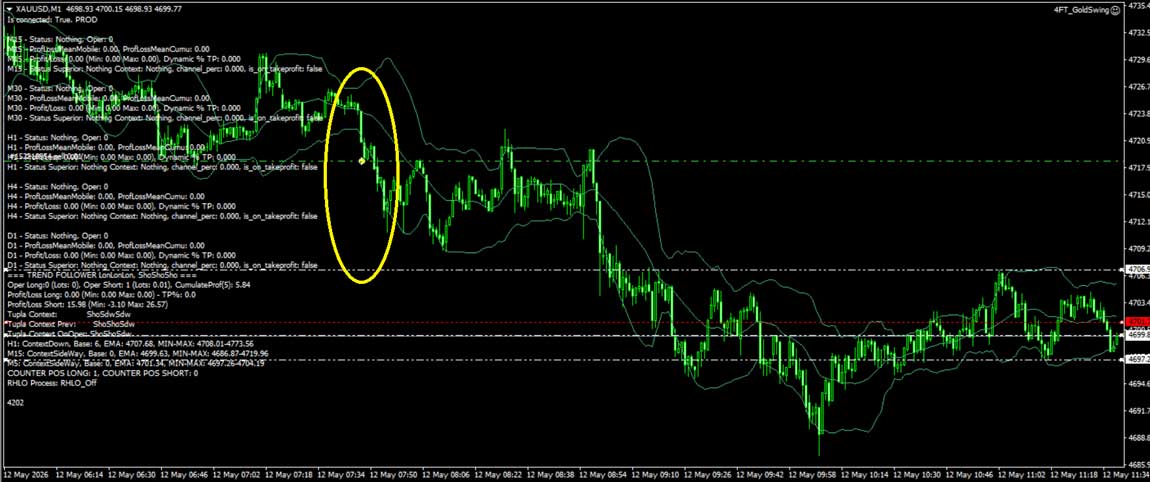
The lesson is clear: in the gold market, the difference is not only about “entering correctly,” but about knowing when a signal loses validity, when risk must be reduced and when the market is offering an opposite opportunity. This is where algorithmic trading can become a tool of discipline, speed and control.
Summary
Gold remains one of the most closely watched assets in the world because it brings together geopolitical fears, rate expectations, confidence in currencies, central bank strategies and global speculative flows. Its volatility is not an anomaly: it is the natural consequence of a market where macroeconomics and technical analysis meet in real time.
In this context, the technological tools of 4FT Invest Ltd aim to support trading activity through advanced algorithms, multi-timeframe reading, dynamic risk management and adaptation to changing market scenarios. The example shows exactly this: a long position quickly closed, a profitable short and a subsequent position still managed, all within a multi-frame logic.
To learn more about the technological approach of 4FT Invest Ltd, you can register at 4FTinvest.com.
Disclaimer: this content is intended exclusively for informational and technological purposes. It does not constitute financial advice, investment recommendation or solicitation of public savings. 4FT Invest Ltd provides technological tools and software solutions for analysis and trading operations, not personalized financial advisory services.
© 4FT Invest LTD. All rights reserved
