
The recovery from the lows offers an early sign of stabilisation. Real yields and fund flows, however, counsel caution
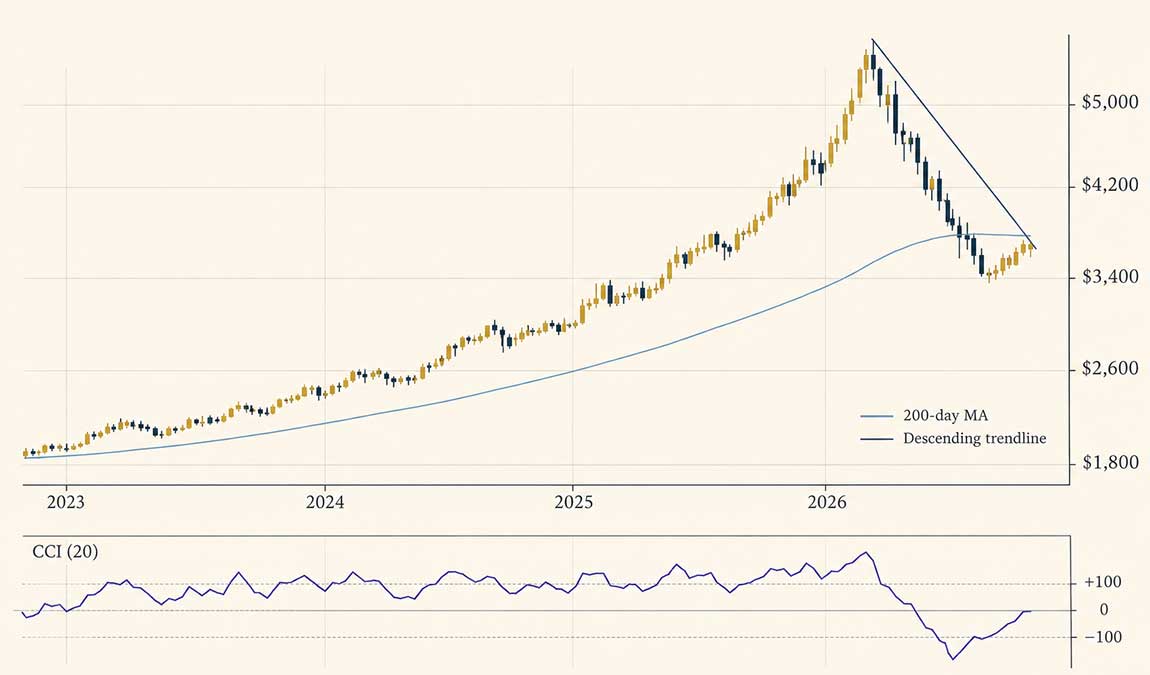
Gold’s recovery from its 25 November lows is significant, but it is not yet enough to declare the correction over. The more cautious reading is that this is a technical rebound within a still fragile structure, with the possibility that a low is forming. Confirmation is still needed before calling this the start of a new bullish phase—and so far, the signals are mixed.
During the session, spot gold fell to around $3,427 an ounce before closing near $3,581, recovering about 4.5% from its intraday low. The price reacted at a level that may attract buyers. But a rebound after a sharp fall can mark the start of a base just as easily as a pause before further selling.
The FXCM weekly chart illustrates the distinction. Since the peak, the pattern has continued to show lower highs and lower lows, with the price below the previous consolidation area. The week is also not yet over, so a provisional candle cannot confirm a reversal on its own. A close above the weekly high, around $3,690, followed by a successful retest of that level, would be an early sign of improvement. A more convincing recovery would also require the price to reclaim previous trading areas, including the $3,850–$3,900 range.
The macroeconomic backdrop is also mixed. The second estimate of US third-quarter GDP showed annualised growth of 4.3%, up from 2.2% in the previous quarter. October PCE inflation rose to 3.8% year on year, while core PCE reached 3.3%; both measures increased by 0.3% over the month. Real consumer spending was nearly unchanged. Strong growth and persistent inflation leave less room for rapid monetary easing, while resilient spending offers a less clear signal of economic cooling.
At its October meeting, the Federal Reserve kept interest rates at 3.75%–4.00%. Two committee members would have preferred a 25-basis-point increase. For gold, which pays no interest or coupon, high rates can be a headwind because they raise the potential return on alternative financial assets.
The fall in yields on 25 November nevertheless helped gold. The 10-year nominal Treasury yield slipped to 4.85% from 4.91% the previous day, while the 10-year real yield fell to 2.73% from 2.79%. But at the end of October, the real yield stood at 2.60%. The recent move is supportive, but has not yet reversed the trend of the preceding weeks. The Federal Reserve’s broad dollar index also rose from 121.67 on 30 October to 123.60 on 20 November, its latest available reading. A stronger dollar tends to make gold more expensive for buyers using other currencies.
Positioning and fund flows have yet to confirm a bullish turn. The latest available COT report captures positions as of 17 November: speculative managers held 121,994 long contracts and 19,052 short contracts, for a net long position of 102,942 contracts, down 9,399 for the week. The data predate the 25 November rebound. The next report, due on 30 November, will cover positions as of 24 November, so it will not capture traders’ response to the following day’s recovery either.
Preliminary CME data show 402,689 contracts traded on 25 November, with open interest up by 1,865 to 375,428. The figures need to be read with care: on the same day, open interest in the December contract fell by 30,853, while open interest in February rose by 30,842. A substantial share of the activity therefore reflects the roll between contract expiries. FXCM chart volume is also not directly comparable with COMEX volume: in forex profiles, “tick volume” counts price updates and does not represent total market-wide trading.
ETF flows add another reason for caution. According to the World Gold Council, European gold ETFs saw outflows of 16 tonnes in November, while North American funds lost 12 tonnes in the latest week monitored. The Council also noted that there was not yet clear evidence of a final liquidation of positions. At the same time, central-bank demand continues to provide underlying support: estimated purchases reached 321 tonnes in the third quarter and 675 tonnes in the first nine months of 2026, 6% more than in the same period a year earlier. This is a medium- to long-term support factor, but offers little help in identifying a short-term low.
Over the coming weeks, whether gold holds the $3,426 area will be an important test. A sustained break below it would weaken the case that a low is already in place. Conversely, a close above $3,690 followed by a successful hold at that level would improve the technical picture; a move back towards $3,850–$3,900 would provide more substantial confirmation.
A reversal would become more credible if rising prices were accompanied by a sustained decline in real yields, a weaker dollar, renewed ETF inflows and improving positioning. For now, the rebound suggests that selling pressure may have eased, but it does not prove that a new bull cycle has begun.

© 4FT Invest LTD. All rights reserved
