
Google Cloud, Visa, and Mastercard are taking an increasingly close look at blockchain infrastructure.
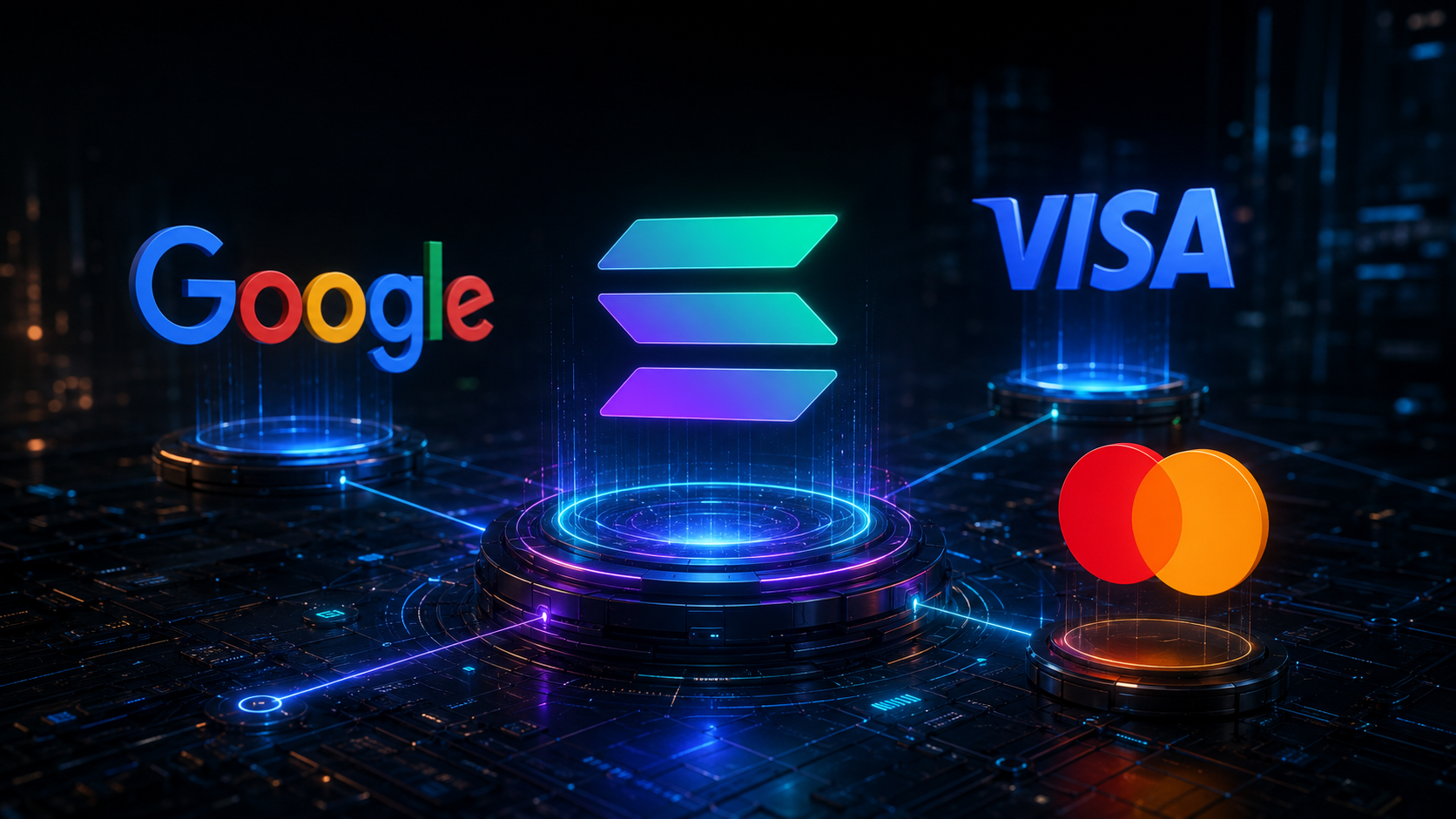
Solana is experiencing one of the most interesting moments in its recent history. On one hand, news is emerging that seems to confirm the project’s maturation: collaborations with major names in technology and payments, new use cases linked to stablecoins, and growing attention from the institutional world. On the other hand, the SOL token continues to behave like many cryptocurrencies: with strong volatility, sudden phases of enthusiasm, and moments of weakness that worry investors.
This is the real paradox: the Solana network seems to be gaining credibility, while its token still struggles to break free from the speculative logic of the crypto market.
In recent days, one of the most relevant pieces of news came from the collaboration between the Solana Foundation and Google Cloud for the launch of Pay.sh, a system that allows artificial intelligence agents to access and pay for APIs using stablecoins on Solana. This does not mean that Google has “moved its payments to Solana,” but the signal is still important: a major cloud infrastructure provider is experimenting with automatic, instant, and programmable payments on a public blockchain. Among the APIs mentioned are also Google Cloud services such as Gemini and BigQuery.
To understand its value, it is enough to imagine a future in which not only people pay for digital services, but also software and AI agents. An automated assistant could buy data, use online tools, pay for individual API calls, and settle everything in real time. In this scenario, a fast and low-cost network like Solana becomes interesting not so much for “trading,” but for enabling continuous small digital payments.
Another signal comes from Visa. The company announced the launch of USDC settlement in the United States, with Cross River Bank and Lead Bank among the first participants to settle with Visa in USDC on the Solana blockchain. Here too, an important clarification is needed: this does not mean that all Visa transactions run on Solana. It does mean, however, that part of the settlement infrastructure — the way financial operators exchange value behind the scenes — can begin to use stablecoins and blockchain.
Mastercard is moving in the same direction, although with a broader approach. Its Crypto Partner Program brings together crypto-native companies, payment providers, and financial institutions to explore how to connect digital assets, programmable payments, and traditional networks. Solana is among the players involved in the program’s ecosystem, a sign that the topic is no longer confined to the crypto niche, but is entering the discussions where the future of global payments is being shaped.
All of this tells the story of a different Solana from the one often associated only with meme coins, NFTs, and speculation. It tells the story of a blockchain trying to become infrastructure: a network on which to build payments, financial applications, stablecoins, business services, and perhaps new models of digital commerce.
And yet, while the industrial news improves, the market remains much colder. Solana is being described not through its collaborations and use cases, but through the weakness of its price and the risk of renewed downward pressure on the token.
This contradiction should not come as a surprise. The value of a blockchain network and the price of its token do not always move together. A technology can be promising, used by important companies, and considered interesting by developers, while its token can still fall. The price also depends on liquidity, investor sentiment, leverage, market fear, profit-taking, and the overall performance of the crypto sector.
It is the same misunderstanding that often accompanies many cryptocurrencies: the adoption of the network is confused with a guarantee of token growth. But it is not that automatic. If a blockchain is used more, it does not necessarily mean that its token will rise immediately. The market wants to understand whether that usage generates real, recurring, and sustainable value.
Solana has some clear advantages on its side: it is fast, has low transaction costs, and has a very active developer community. These features make it interesting for payments and for applications that need to handle many operations in a short period of time. But some open questions remain: how stable will the network be over the long term? How sustainable will the economic model be? How much of the activity will truly be linked to real use cases, and how much will remain speculative?
Solana’s current phase, therefore, should be read neither with blind enthusiasm nor with automatic skepticism. It is a blockchain trying to make a leap in quality: from a very lively crypto ecosystem to a more mature financial and technological infrastructure. But the market is not yet granting it full confidence.
The central point is exactly this: Solana is gaining attention among major payment players, but SOL remains a risky, volatile asset tied to the emotional cycles of the crypto market.
For investors and observers, the question is not only whether Solana will secure more important partnerships. The real question is whether these partnerships will turn into stable usage, revenues, concrete demand, and lasting trust.
Until then, Solana will continue to live within its paradox: a blockchain increasingly watched by major names in technology and finance, but with a token that still has to prove it can withstand the weight of expectations.
Solana is one of the most interesting cases for understanding where the blockchain world is heading. We are no longer in the phase where promising speed and decentralization was enough to attract attention. Today, concrete use cases, credible partners, and applications that solve real problems are needed.
The news involving Google Cloud, Visa, and Mastercard should not be read as a definitive coronation, but neither should it be underestimated. It indicates that large companies are looking at blockchains not only as a speculative phenomenon, but as a possible infrastructure for payments, stablecoins, and automated digital services.
At the same time, the weakness of the token reminds us of one simple thing: technological innovation does not eliminate financial risk. Solana can be promising as a network and fragile as an investment. And it is precisely in this gap between technology and market that its most important battle will be fought.
© 4FT Invest LTD. All rights reserved
